

This post is about the delicate matter of the master’s son taking advantage of a household servant, and his attempt to wriggle out of paying for his behaviour. If you are easily shocked, please read no further.
The Sussex Advertiser of the 24 March 1863 has a detailed account of the proceedings before the Bench. It is unusually frank (if coy at times), and even has exact dates. It would have been before an audience, as legal proceedings were (as now) a source of free entertainment at the time. However, sometimes women and children were, we are told, cleared from the room before evidence was given, evidence which would be only hinted at in the court reporter’s account.
AFFILIATION
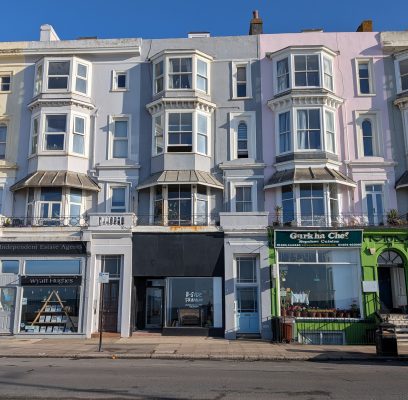
James Hayward, painter, of 19, Grand Parade, was summoned on the complaint of Jemima Reed, single woman, to show cause why he should not contribute towards the support of her illegitimate child, of which she alleged that he was the father.
Mr Langham appeared for complainant.
From the evidence of complainant it appeared that she had been in service at 19, Grand Parade, which was a lodging house kept by defendant’s father. She went there on the 26th March, and remained till 12th Nov. 1862. Soon after she went there defendant kissed her, which she did not regard as anything very improper, and on the night of Saturday, the 19th April, a greater intimacy took place between them, in defendant’s room. The intimacy was continued at different times till the 17th Sept. When she informed him of the result he told her to take no notice to anyone in the house, and she should come to no harm. The child was born on the 6th February last. Before she left her mistress accused her of being enceinte, and she told her who was the father of the child.
Defendant cross-examined the complainant with a view of shaking her evidence, but failed in doing so. She admitted that on one occasion she took the key of his bed-room door, but said it was to fasten the door of her room. She did not go into his room when he was asleep, and had never knocked at his door. She went out on Whit Monday, but returned at 11 o’clock and did not stay all night. She did not tell him she had been on the beach with another girl and “two chaps.”
Harriet Lever, who had been a fellow servant of complainant’s at the house in question, corroborated her evidence on some of the principal points She deposed to seeing defendant pull complainant into his room, and to observing other signs of intimacy.
Defendant at first strictly denied the paternity, and afterwards endeavoured to defend himself by saying that complainant had given him great liberties. He made statements which, if true, showed that such was the case.
Mr Langham reminded him that that had nothing to do with the question which the Magistrates had to decide.
The Bench considered that complainant had proved her case and ordered defendant to pay 2s a week from the date of application and the usual costs.
After Jemima told the mistress of the house who the father was, an interesting ‘interview’ must have followed between James and his mother.
Two shillings a week seems to have been the standard rate at the time for maintenance for illegitimate children, judging from local newspaper accounts, although it seems that poorer fathers could get away with paying a little less. Affiliation orders were provided for by the Poor Law Amendment Act of 1844. The onus was on the mother to provide evidence of paternity such as letters, or that he had paid money to her during pregnancy, or other signs that intimacy had occurred. Hence the importance of the fellow servant providing (unstated) evidence implying intimacy.
I could not identify a baptism. The household at 19 Grand Parade had been as follows in the census held on the 7 April 1861:
Richard Hayward, married, 56, gardener, born Sussex St Leonards
Maria Hayward, wife, 52, lodging house keeper, birthplace unknown
Charlotte Hayward, dau, U[nmarried], 30, cook, born Sussex Hollington
James Hayward, son, U, 25, cabinet maker, born Sussex St Leonards
Annie Atkins, dau, W[idow], 20, seamstress, born Sussex St Leonards
Agnes Maria Atkins, gd dau, 2, scholar, born Lincolnshire
[Plus four visitors]Jemima Reed was apparently not in Sussex in the same census, and nor was Harriet Lever, the other servant.
About nine months after these court proceedings, James Hayward married, on the 14 December 1863, at St Mary Magdalen, Mary Ann Richardson. From being a cabinet maker in 1861 he was now a paper hanger.

In the 1871 census that couple were at 1 & 2 Melbourne Place off Western Road with four children. This is approximately the location of the Prince of Wales public house. James died in about 1878, aged 42. His father died at 8 Warrior Square in 1882, his mother at the same address in 1883, with their son George William Hayward of 34 Marina, a builder, the executor.
As for the unfortunate Jemima Reed, I could not trace her further.
Have just moved to St leonards so very i interesting to know the history