

The former Anchor pub is almost hidden up an alley from East Ascent, and is now numbered 5a East Ascent. As with the other buildings on the road, it is almost certainly a James Burton designed house. Access is either from an alley leading up from East Ascent or from its continuation, going forward from the gate shown in the photo below, then up stairs to the left beyond the house, then a turning to the right.
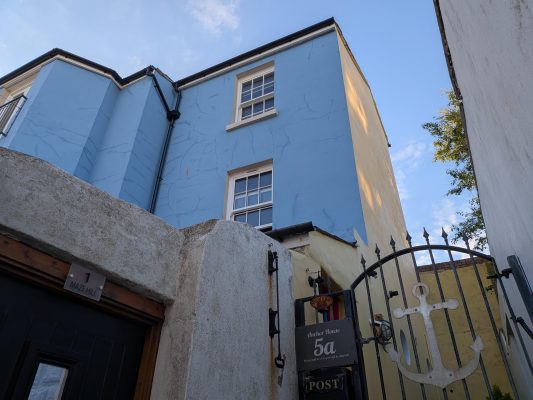
This would have, in the past, led to a passage between buildings to Victoria Mews, which as the name suggests was an area of stables to serve the gentry in the local area. Newspaper mentions make it clear that the workers in this area formed much of the pub’s clientele. The extract from the 1874 map shown below indicates, with the elongated X, that the passage was covered over at the time. As we shall see, the police were not happy about the difficulty of surveillance. The stairs are easily seen in the map: one to the northeast of the building, and two on the alley leading up from East Ascent.

The 1954 Ordnance Survey map at https://maps.nls.uk/view/144909733 has, at far right, buildings numbered 3-8 Victoria Mews immediately to the north of 5a. These are now all gone. The two small unnumbered buildlngs immediately to the west of the alley leading to Victoria Mews are now 5a’s walled garden, with grapevines on a pergola. The larger building to their west, and the still larger building to the northwest shown on the 1872 map are also gone. The pig pounds that used to be in the back gardens were removed in 1834… apparently they were smelt rather than seen.
5a dates from at least 1838, and I suspect is earlier, as East Ascent itself was built by 1830. The lack of planning applications means we can have little idea of its layout, which no doubt has been altered over the years. After its closure in 1905 it was a boarding house for many years. Including building into the attic, there are four floors. There are now porthole windows, and small skylights, and views in all directions except the west, where it backs on to 1 Maze Hill. It is presently for sale.
I have used the names supplied in David Russell’s Register of Licensees for Hastings & St Leonards 1500-2000 to help identify the licencees. I suspect that the official lists that were used in its compilation were both incomplete and relied on the annual renewals each autumn rather than the occasional transfer of licences between the annual Brewster Sessions. This is of course not a criticism of what must have taken a great deal of work. I will cite the book as Russell in this post. I used census returns, Anglican marriage certificates and newspaper mentions to add other details. Although valuable, searching the newspapers involved interrogating scanned text, and some material was almost certainly missed, apart from the fact that not all local newspapers are necessarily available on priced sites.
Russell cites Thomas Cooper in 1839 as the first licencee. The Sussex Advertiser, 27 August 1838, gives details of the annual licensing day. Among the applicants were ‘Mr T. Cooper for a house on the East Ascent, St Leonard’s.’ The other five applications, from Hastings, were refused, and this was the only one new license to be granted, with his name spelt out as Thomas Cooper.
The household appears in the 1841 census on what it calls Mews Passage as follows:
Thomas Cooper, 40, innkeeper, N
Elizabeth Cooper, 40, N
Thomas Cooper, 11, N
Sarah Cooper, 8, N
Louisa Weston, 20, F.S., Y
John Clark, 30, M.S., S
Charles Sisley, 25, M.S., No
The 1841 census gives little information and is hard for the novice to interpret. The N at the end of the entries meant that they were not born in the county, but elsewhere in England, while the Y for Weston means yes, she was born in Sussex. Clark was born in Scotland, hence the S. Sisley appears to have been born outside the British Isles. The ages of adults are rounded down to zeroes and fives. F.S. was a female servant, while M.S. was a male servant.
Russell next cites William Skinner in 1845. Like Cooper, I cannot add information about him from the newspapers.
The Hastings and St Leonards News, 30 June 1848, mentions the next innkeeper:
May 23, at the Anchor Inn, St Leonards, the wife of Mr James Ballard, of a son.
The 1850 electoral register lists voter James Ballard at the Anchor Inn, East Ascent. In the 30 March 1851 census we find him at the Anchor Inn as a 52-year-old born at Portsea, Hampshire. His wife Mary was 42, born Middlesex, and there were seven children. The eldest, Elizabeth, age 32, presumably came from an earlier marriage or relationship. Two-year-old Thomas was born in St Leonards, and was the boy in the newspaper announcement, while his older siblings up to age twelve were born in Hastings. With the hint that Ballard was in Hastings in 1841, I was able to identify him as a coach proprietor in Bourn Street, Hastings old town, in the 1841 census.
Sadly James Ballard was buried less than six weeks later, on the 10 May 1851, in St Leonards parish, age 53. Very frequently widows took over their husbands’ licenses, and so Russell cited Mary Ballard in 1852. In the 1861 census she was on nearby Norman Road, age 50, a nurse, born Staines, Middlesex. She had four children living with her, all of whom were earning their keep: Ellen, 18, dressmaker; Edward, 17, gardener; Fanny, 14, servant; and Thomas, 11, errand boy.
The 27 March 1857 edition of the London Gazette has a brief mention of a petition by an insolvent debtor. Insolvents were different from bankrupts, as the former could go to prison if they could not satisfy their creditors.
George William Phillimore Stevens commonly George Stevens, formerly of the Anchor Inn, East Ascent, innkeeper and licensed victualler, then of the Thurlow Arms, 161 Edward Street, Brighton, and now of 9 South Street, Brighton, out of business.
There is some evidence of when Stevens was at the Anchor. The Hastings and St Leonards News, 20 April 1855, recorded the death on the 15 April of his four-year-old daughter Martha, he being of the Anchor Inn. On the 31 August 1855, St Clement’s Hastings, as a licensed victualler, of St Leonards on Sea, he and Rosetta baptised their daughter Georgiana Caroline. In the 1861 census the family were in Lambeth, he age 39, born Leicestershire, coffee house keeper, with wife Rosetta, 36, born in Stepney.
The Hastings and St Leonards News, 4 July 1856, mentions the transfer of the license from George Stevens to Thomas Vido by endorsement (that word meant that Vido could immediately begin trading). It appears that the run of licences that was used by Russell is incomplete, as he cites Vido for 1866-69.
Thomas Vidow or Vido had married at Battle, in 1850, as a 31-year-old bricklayer of Battle, son of a blacksmith, Elizabeth Jane Godden, 28, servant. Her father was not named. He put an X on the marriage certificate while she signed. It is extraordinary to think that an illiterate man was able to run a pub for many years.
Thomas Brandon Brett decided, in excruciatingly bad poetry, to mention them in his own newspaper, the St Leonards and Hastings Gazette, 10 June 1882. Titled ‘Cavendish House’, it is a comic history of what became 1 to 3 Cavendish Cottages in Hastings old town, near St Clement’s church. The portion titled ‘No. 3 Cavendish Cottage’ ends the poem with these five stanzas:
Then, in ‘Forty-eight – less further from us –
When the house belongs to Edward Reed,
Owner’s tenant will be Betsy Thomas,
Who a Thomas Vidow will succeed.
Thomas Vidow Godden Miss, will marry,
Two years after Eighteen-forty three;
Either here or somewhere else to tarry,
At St Leonards afterward to be.
Not in bus’ness as a wealthy banker,
But as Boniface, his bread to win,
Vido will be serving at the Anchor –
Need I further say, the Anchor Inn ?
Failing health his prospects will have stinted,
Though his wife will be the first to die;
Long before my story can be printed
In their silent graves they both will lie.
Prematurely Death will seem to nick’em;
But to this, T. Vido’s first abode,
Come I back, where Mr Humphrey Wickham
Once his slaughtered sheep and oxen stowed.
The couple married in 1850 rather than 1845. The Vidows were not at Cavendish Cottages in the 1851 census, and indeed I could not find them anywhere.
The Sussex Advertiser, 6 July 1858, had this interesting account of a fight:
Samuel French v Henry Curteis. — A summons for an assault.
From the statement of the complainant, it appeared that on the evening of Saturday, the 26th ult., he was in the company of the defendant at the Anchor Inn, St Mary Magdalen, where they had two glasses of brandy and water. Defendant complained of his drink being weak, and began to quarrel with the landlord (Vidow) about it. Thinking that defendant would strike Vidow, he stepped between them, when defendant struck him several times in the face, causing blood to flow.
Complainant’s statement was corroborated by a young man named John Spice, hostler at the Victoria Mews.
The landlord, Thomas Vidow, likewise gave evidence as to the disturbance made by defendant, but said he saw no blows struck. Complainant and defendant were in liquor.
Defendant said that complainant seized him, which caused the disturbance between them.
Sergt. Wood stated that he heard a disturbance in the passage adjoining the Anchor, and on going in he saw complainant and defendant scuffling. He heard defendant say, “if there is six of St Leonards to one of Hastings I shall not be drove by them.” He advised the defendant to go home, and he went away immediately, but the landlord called him back and endeavoured to keep him there longer. Both complainant, defendant, and the landlord were intoxicated, one as much as the other, and the witness Spice was not present when the disturbance took place.
The magistrates dismissed the case.
In the 1861 census, between 2 Victoria Mews and 1 Maze Hill Road, was the Anchor Inn:
Thomas Vidow, head, 41, victualler, born Worcestershire Gainsbridge
Elizabeth Vidow, wife, 39, born Wiltshire
Elizabeth Vidow, daughter, 8, scholar, born Sussex
Thomas M. Vidow, son, 6, scholar, born Sussex
John Vidow, son, 5, scholar, born France (British subject)
Edward Vidow, son, 3, scholar, born Sussex St Leonards
William H. Vidow, son, 9 mos, born Sussex St Leonards
Plus servant, five boarders (two grooms, three coachmen), so twelve in all. The five-year-old being born in France is intriguing.
The Hastings and St Leonards News, 28 December 1866, listed this death entry:
December 19, at the Anchor inn, St Leonards, Elizabeth, wife of Mr Thomas Vidow, aged 45 years; leaving seven small children.
The Observer, 18 December 1869, reported on a fracas at the pub:
CARDS AND QUARRELLING. – WILLIAM MITTEN, stable keeper, was summoned for having unlawfully beaten William Gaskin at “The Anchor,” St Leonards.
The complainant, whose left eye was bandaged up, said – Last Friday evening he went to Mr Vido’s public house, and played at cards with the defendant. Defendant lost and instead of paying abused and struck complainant knocking him down, and after he got up he was going away to escape defendant, defendant follow[ed] him out and kicked him in the back.
The complainant had summoned two witnesses, but the magistrates expressed themselves satisfied with the defendant’s plea of guilt and complainant’s statement.
Defendant said he was playing cards with the complainant, who began, and in spite of defendant’s remonstrances, continued to cheat. Defendant offered him 7d, and complainant demanded 10d, which defendant refused to pay. Complainant abused him and kicked him, and he retaliated by striking complainant.
The Mayor said there was no doubt the defendant had committed a very violent assault, whatever might have occurred previously, she [sic] must pay a fine of 25s including costs, in default fourteen days imprisonment.
Supt. Glenister then applied for a summons against Mr Vido for permitting card playing in his house. He thought that it was time a stop was put to this kind of thing whether in hotels or public houses.
To put the money amounts into modern terms, the offered seven pence was equivalent to just over £3, and the ten pence just over £4. The fine would have been £130. As a result of Supt. Glenister’s intervention, Vido appeared before the magistrates, as reported in the Hastings and St Leonards News, 24 December 1869:
MORE GAMBLING. – Thomas Vido, of the Anchor Inn, St Leonards, was summoned for knowingly permitting gaming to be carried on in his licensed house.
Superintendent Glenister, in laying the charge, said that defendant had conducted the house fourteen years without previous complaint against him.
Defendant pleaded guilty, and said he was ignorant of the law on the subject.
Fined £1, including costs. The money was paid.
Vidow died in 1876 or 1877 in the district of Hastings aged 67, as indexed in civil registration.
The license went from Thomas Vido to Jeremiah Crittenden (Hastings and St Leonards News, 6 May 1870). Russell cites J. Cruttenden (probably a spelling mistake on the licence) for 1870-71. In the 2 April 1871 census the household at Anchor Inn, 5 East Ascent was:
Jeremiah Crittenden, head, 43, publican, born Sussex St Leonards
Barbara Crittenden, wife, 41, born Sussex Hooe
Alice Lynn, servt, single, 18, servant, born Sussex Brighton
In the 1861 census the couple had been at Beach Cottage, Hastings, he a bricklayer, she a laundress, with son George, 7, born St Leonards (who I could not trace further). They had married on the 23 June 1850 at St Leonards church, she as Elphick.
They were not long at the Anchor. The Observer, 19 August 1871 recorded the license being transferred from Jeremiah Crittenden to Tom Wells. The Crittendens emigrated to America, and in the 1880 census were in Wisconsin, where Jeremiah was a farmer.
Wells came from the Tivoli Tavern in Silverhill, where he and his family were in the 1871 census. Russell cites him for 1872-95. There are quite a few newspaper mentions of him.
This account of Wells, Hastings and St Leonards News, 7 June 1872, is quite amusing:
Tom Wells, landlord of the Anchor Inn, Victoria Mews, appeared to answer a summons for having opened his house for the sale of beer, at 11.45 on Sunday morning last.
Defendant — I am guilty of having the house open, but as to the sale it was an accident. The boatmen had been drawing up their boats, and wanted something to drink, and I let them have it.
The Clerk — Then you plead guilty.
Mr Glenister said there had been no previous complaint against the house.
The Mayor — The fine is £1, including costs, or fourteen days’ imprisonment in default.
Defendant — Fourteen days ! I would rather pay the money. I’ll take care it does not happen again.
In the Observer, 22 November 1873, another case of being open illegally on a Sunday morning, despite his vow:
ILLEGALLY OPENING THE ANCHOR INN, HASTINGS. Thomas Wells was charged with opening his house – the Anchor Inn – at an unlawful hour. – Mr Davenport Jones appeared for defendant. – P.C. Weston deposed: on Sunday morning last, at twenty past eleven, he was on duty in East Ascent, in plain clothes. He saw a girl go towards defendant’s house, in the mews at the back of East Ascent, with a clear glass bottle in her hand. He saw her knock at the door, and she was admitted. He heard her ask for sixpennyworth of brandy, and saw her come out shortly afterwards with something in her bottle of the colour of pale brandy. He then saw a man named Day come down and look down East Ascent, come back, and go into the house. He left the door ajar, and witness followed him. He heard him say, “A pint of porter,” and hear the beer-engine being used, and, looking in over the window, he saw the defendant pouring some stout or porter into the bottle, through a funnel. Day then put the bottle into his pocket, and came out. The man Day said to him, “It’s all right; you can go in.” Wells came to the door, and he said, “You are aware of the time.” Defendant said, “You did not see me draw anything.” Witness said, “No, I did not see you, but heard you pouring it into the bottle.” – Mr Jones having addressed the Bench for the defence, Thomas Wells, the defendant, deposed to keeping the Anchor Inn. A man named Day was in his house on Saturday last, and asked him to put a pint and a half of ale in the bottle for him, as he was going to work to-morrow. He gave witness a shilling and received 7 ½ d in change. In consequence of what he had told him defendant kept the bottle in his house until eleven o’clock the following day. Day did not ask for a pint of porter. Weston said, “Tou have no right to draw beer in a prohibited hour.” Witness said, “I haven’t.” He replied, “I saw you.” Witness said, “I haven’t.” He replied, “I saw you.” Witness then said, “It was bought last night.” He then closed the door and went away. He did supply a little girl with some brandy. He gave it. She did not pay for it. Witness did not hear any conversation take place between Day and Weston. – Mary Emma Weeks, wife of George Weeks, deposed to her son meeting with an accident from an explosion of gunpowder, about eleven o’clock, and was frightfully burnt. She was nearly fainting, and sent her daughter for some brandy. Witness did not pay for it. – Alfred Day, a coachman, stated that on Saturday last, he was in the Anchor, about ten minutes to eleven o’clock and ordered some ale for the Sunday morning. Witness asked him if he had a bottle, in which he would put some ale for him. Defendant replied that he would do it. He went there on the following morning shortly after eleven to call for this bottle. He saw a policeman previous to going in, and he then called for his bottle at the public house and went away. Witness did not see Mr Wells draw any beer that morning. On coming out he did not speak to the policeman. – By the Mayor: I will swear I saw and spoke to the policeman before I went into the public house. – William Cuthbert, residing at No. 1, Harold-mews, gave similar evidence to the last witness. – The magistrates having consulted for some few minutes, the Mayor gave the decision as follows: — the Bench have decided on conviction, and the fine will be £1, and 17s costs, the license not to be endorsed. In default of payment 14 days’ hard labour.
Publicans tried to avoid being fined not so much because of the cost but because, at the annual renewal process before magistrates called the Brewster Sessions, they might be thought of as unsuitable licensees. The Hastings Independent, 21 November 1873, gave a slightly different version, and had Wells saying that the policeman had told ‘an infernal lie’. He had given the girl the brandy for free out of humanity on hearing that her brother was badly burnt. In August 1874, the next Brewster Session, his license was renewed but, along with three Hastings publicans, he was cautioned as he had incurred a fine.
The Hastings and St Leonards News, 23 January 1874, has a short account of coal being stolen from Wells’ fire. Coal was certainly needed if you wanted to roast chestnuts ! I wonder if Walter was a relative of the previous licencee.
STEALING COAL. – Walter Ransom, a dealer in roasted chestnuts, was charged with stealing coal, the property of Tom Wells, Anchor Inn.
Walter Crittenden, a labourer, lodging at the Anchor Inn, East ascent, said that on Friday, about four o’clock, he was in the bagatelle room with prisoner and eight or ten others. Prisoner had a chestnut roaster with him. After playing bagatelle for a while prisoner went to the fire and took enough live coal off to fill a half-gallon measure.
Tom Wells said that prisoner told him he had taken a “few bits” of coal off the fire. Witness said nothing, but went into the bagatelle room, and found all the fire taken out of the grate.
Cross-examined – He had taken chestnuts from prisoner’s tin occasionally.
The Mayor said the accused had placed himself in a very awkward position by taking these coals, but the Bench believed he had no felonious intention, and they dismissed the case.
The next mention was in the Observer, 14 February 1874. Titled STEALING A CASE OF RAZORS, it involved Samuel French, formerly a boatman, of St Leonards. He was alleged to have stolen a case containing two razors belonging to George Barnes, a hairdresser in Norman Road West, apparently at his shop. In relation to the Anchor, the interesting part is a witness statement:
James Taylor, livery stable keeper, living at 19, Norman-road West, deposed that on Wednesday, the 4th inst., between eleven and twelve, he went into the bar parlour of the Anchor Inn, St Leonards. Prisoner was there, sitting by the fire. Shortly after witness entered the room prisoner pulled a case out of his pocket and said it contained two razors. He offered to sell them to him for 1s 6d, but witness said he did not want them. Prisoner said they were given to him by Mr Eversfield, who had left off shaving and did not want them…
Taylor ended up paying the requested eighteen pence. The next witness, Sergt. Cripps, said he had apprehended the prisoner the previous evening at the Anchor Inn, Mews Road, and charged him with theft. French claimed he had bought the razors for sixpence off a razor grinder. He had mentioned Eversfield, the wealthy landowner, to up the price. French (a notorious old lag) was sentenced to three months’ hard labour. 1s 6d would be equivalent to about £7.50 today — so he paid a stiff price, as it were.
In the Hastings and St Leonards News, 12 November 1880, Tom Wells was summoned for supplying beer to a policeman on duty. PC Ashdown had called at the defendant’s house on the 6th at 11 am, in uniform and with an armlet. He went into the bar and called for a pint of porter. Wells’ excuse was that he did not notice who called for the beer as the bar was full. He was fined £2 and 13s costs, which seems harsh if only because there was no mention of any reprimand for Ashdown. A certain Thomas Gardiner, also in the bar at the time, informed on Wells to the authorities.
In 1881 Wells asked the magistrates for six-day licence rather than a seven-day licence, which was granted. This was an innovation under the Licensing Act of 1872, under pressure from temperance advocates and churches. Six-day licences were cheaper, in exchange of course for being closed on Sundays. They also meant no temptation to open early during ‘divine services’, as Wells had discovered to his cost in 1873.
In the 1881 census, listed between 6 and 5 East Ascent, as ‘Anchor Inn, Pub Ho’, was Thomas Wells, 46, licensed victualler, born Burlingham, Norfolk; wife Annie, 40, born Suffolk; three children aged 10 to 18, all born Mountfield, including Minnie, 16, ‘paralysed from birth’; three children aged 1 to 5, all born St Leonards; also a 19-year-old niece, no occupation stated, who I suspect was a barmaid. Nine in all.
The Sussex Express, 12 June 1883, reported on a fire. We are later told he was a fly proprietor — renting out carriages, for use as taxis — which explains the interest in hay.
AGRICULTURAL FIRE. – A hay stack, belonging to Mr T. Wells, of the Anchor Inn, St Leonards, and situated at Bohemia, took fire on Wednesday afternoon. The stack, which was valued at £30, had recently been bought by Mr Wells, and was not insured. The St Leonards Steam Fire Brigade arrived about six o’clock, and put the fire out.
The South Eastern Advertiser, 26 May 1888, has an account of Wells being approached to buy a stolen item. William Walsgrove was charged with stealing a silver chain and locket from Clara Field, a cook, his half-sister. She had visited him at his house in Union Street and later realised that she had been robbed. She gave information to the police. Wells was at the Royal Hotel when a servant there approached him and asked if the chain was worth half a crown. His reply was “Yes, he would give 2s 6d for it”, which he did. Another witness was Edward Barnes, barman at the Yorkshire Grey, who while in the bar was offered the locket by Walsgrove for two shillings.
The 1891 Kelly’s directory lists Thos. Wells at the Anchor Inn, East Ascent, and also as a fly proprietor at Harold Mews. The same year the family was again, in the census, at the Anchor, with five children and a visitor.
The South-Eastern Advertiser, 5 May 1894, has this sad story:
A BREACH of promise case, in which the plaintiff concerned was a Hastings lady, was tried in the County of London Sheriff’s Court on Friday. The parties were Miss Wells, daughter of the landlord of the Anchor Inn, St Leonards, and Mr Cook, manager of the hairdressing department of the Grand Hotel, Charing Cross. A further local connection was presented in the fact that Mr T.M. Stevens, who may be described as a Hastings man, appeared for the plaintiff. Miss Wells, a tall, fashionably-dressed young woman, stated that the defendant told her he was earning £10 per week, and that she gave up her situation in order to get married, but subsequently obtained another. Eventually the jury assessed the damages at £25 [plus costs].
Breach of promise to marry only ceased to be illegal in 1971. Much more detail is in the Observer, 28 April 1894, which added that her name was Annie, aged 23. The job she gave up was as a barmaid at the restaurant at Charing Cross station, and her new job was at the Poulterers’ Arms, Cheapside. Three weeks before the planned wedding Cook told her that he was married. At one point she told Cook that she had had an illegitimate child. The £25 award was equivalent to just under £2,900 today. I could not trace Annie further (or her child).
The Observer, 13 May 1895, has a brief notice about Wells getting in trouble with his landlord:
Burton v Wells. Claim for £30 7s 6d, rent and insurance, against the late tenant of the Anchor Inn, St Leonards. Judgment for the amount claimed, less £5 11s 6d, payment in fourteen days.
Wells turned up again when he went bankrupt, in the Hastings and Bexhill Independent, 9 January 1896. It was his adjourned public examination (about his debts). He was questioned by Mr Burton’s lawyer regarding ‘certain betting transactions.’ Final closing was set for the 27 January. The London Gazette, 29 November 1895, gave his address as 39 Gensing Road, retired licensed victualler, with a petition by his creditors [rather than by him] being dated 4 November 1895.
The Hastings and Bexhill Independent, 19 December 1895, gave much detail about Wells’ affairs, with the title ‘A PUBLICAN’S FAILURE’. It was his landlord, Mr Burton, who had filed the bankruptcy petition against Wells.
It was elicited from Mr Wells that he started business in 1871, when he took the Tivoli Tavern with a capital of £500. He had saved this money whilst in a gentleman’s service in the capacity of gardener. After remaining at the Tivoli for a year he left and became proprietor of the Anchor. He paid £325 to go in. At this time some of his money was invested in London and County Bank shares, and the bank advanced him money on the shares. He also had £50 in a building society. Whilst at the Anchor he carried on business as a fly proprietor and at one time he had a dozen horses and vehicles. Questioned as to betting, debtor denied that he was in the habit of betting; he was in the habit of “executing commissions,” and had done so for more than twenty years. He complained that his landlord (Mr Burton) heavily rented the Anchor and impoverished it. He denied that things mentioned in the lease as belonging to the landlord were given to him in order that he might make a better price of the concern. The things were his own property.
It was only in a 1905 hearing that Burton is identified as A.H. Burton, who had the property on a long lease from the Rev. J.W. Tottenham, who had purchased the freehold in 1873. Alfred Henry Burton (1846-1917) was son of Alfred and grandson of James Burton. He was a Deputy Lieutenant and JP. His probate entry states that he was both of 18 Manson Place, South Kensington, and St Leonards Lodge, Maze Hill. His estate was valued at £80,000, equivalent to just under five million pounds today.
The Hastings and St Leonards News, 20 December 1895, had the same but then added much detail, often amusing, about Wells and the horses and other matters, under the title ‘A SPORTING PUBLICAN.’ He had sold three billiard tables to raise money but denied it was to forestall the bailiffs. ‘When he left the house he received £131 which he paid to several creditors’, thinking that those who had lent him money should have preference. He claimed not to put his own money on horses for many years but rather received commissions on bets placed by others, but then said he had been running his own book since Ténébreuse won Cesarewitch, when he had 500 customers, while now it was about 25. He had not mentioned the commission business because it was illegal, and he destroyed papers each week ‘as it wouldn’t do to keep records.’
In the 1901 census, 20 Gensing Road, Annie Wells was a widow, age 38, a charwoman, living with five relatives. I could not trace Tom’s death as it is a common name. As we shall see she and her husband are referred to in 1905.
This is perhaps the place to refer again to Thomas Brandon Brett, the contemporary chronicler of St Leonards, who wrote his reminiscences, based partly on his notes and partly on his memory. Many of these appeared in his own newspaper. Brett’s Gazette, 11 March 1896, has this somewhat enigmatic extract, spanning many years. The stone-yard and clerk’s office mentioned in the first sentence were that of ‘a gentleman named Hopkinson, who was the ground-landlord of their houses in East Ascent.’ Mews Passage was the short alley leading to 5a from East Ascent itself.
…The entrance to the stone-yard and clerk’s office in question was by a doorway in a passage leading up between Nos. 5 and 6 East Ascent to the Anchor Inn and to the coachmen’s dwellings in the St Leonards Mews. The avenue was called Mews Passage, the entrance to the works being on the right hand side, where a similar door still marks the spot, where still exists the somewhat rugged wall which was then hastily “run up,” and which at the present time is a curiosity in its way. The Anchor Inn, to which the passage also serves as an approach, and which – as its name indicates – bears alike the arms of the town and its founder, was at first a beer-house only, Mr Burton having previously stipulated with Mr Milstead, of the Horse-and-Groom Inn, that there should be no full-licensed house between the last-named and the St Leonards Tap, beneath the Hotel. The Anchor has been successively tenanted by Mr Ballard, Mr Cooper, Mr Skinner, Mr Vidow and Mr Wells. It is here about that the buildings exhibit the greatest traces of decay. The stables, coach-houses, walls, etc., being among the first erections of the town, and composed almost solely of friable sandstone, have yielded to the influence of time and the weather, and at the present moment present quite a contrast to the other early erections which have been preserved by their external coatings of cement and paint…
Russell cites William King for 1895. The Hastings and St Leonards News, 3 May 1895, simply states that the license was endorsed to a new tenant without naming the old or the new licensee (though Thomas King is named in the Observer, 11 May 1895). The first mention was ten days before we hear of Wells’ initial problems with his landlord. However, it appears to have been a brief stay for King, as Russell cites William White for 1896, and then George Payne for 1897. The Hastings and St Leonards News, 23 October 1896, recorded the transfer of the licence from William King to William White. The Observer, 27 March 1897, in turn recorded the transfer to G. Payne. Shortly after, a new Buffalo Lodge, of the Grand Order of England, was instituted at The Anchor, as the Royal Victoria Lodge. Payne was apparently a member, as he was named as the Primo of the lodge (Observer, 8 May 1897).
Russell cites Henry Cruttenden for 1898-99. It is quite likely that he was the man who in the 1891 census was innkeeper of the Bull Inn in Bulverhythe. He was 29, born Bexhill, married to Deborah, 24, born Catsfield, with young sons Harold and Henry. If so, though, he was back at the Bull in the 1901 census, with two more children. I checked the baptism of the youngest to see if it mentioned an address. This was Hilda Annie, baptised at Bexhill on the 25 April 1897. The father was a ‘deceased victualler’, but the 1901 census makes it clear it’s the same family.
Russell cites Frederick Smith for 1900-02. The 1901 census for ‘Anchor Inn Behind No. 5 E Ascent’ has this family:
Frederick Smith, head, 34, licensed victualler, born Sussex Brighton
Agnes Smith, wife, 36, born Hants Penton
William Smith, son, 6, born Lancs Greenheys
Margaret Rothwell, sister, married, 30, born Sussex Brighton
Frederick A. Rothwell, nephew, 1, born Sussex Brighton
Russell cites Frederick Gage for 1902, and then George Dunk for 1903-05. In the 1881 census Dunk was living with his parents at 1 Cross Street, son of a general labourer; he was 16, porter to a stationer. In the 1891 and 1901 censuses he was porter at 1 and 3 Warrior Square, the East Sussex Club, as confirmed later in his obituary.
On the 4 March 1905 the Hastings and St Leonards Observer reported in detail on license renewal refusals for seven St Leonards public houses. There were three reasons for closing: not required to meet needs of the neighbourhood; too many licences; in the general interest of the public the renewal was not desirable. It was felt that pubs that were struggling to survive were an evil and needed to be closed down. Compensation was paid not out of public funds, but by a tax on all publicans ! The amounts paid out varied, with typically some going to the licensee, but much more to the owners of the pub. In this case it was more complicated. It appears from the account that George Dunk was drunk !
THE ANCHOR, EAST ASCENT
Stating his case against this fully-licensed house, the Chief Constable said it was situate in a passage leading from the street to Victoria Mews. The house was approached by twenty steps, and in order to get to it customers had to pass a urinal built to accommodate one person. No part of the house could be seen from the road, and it was very difficult for purposes of police supervision. He also cited the frequent transfer of the licence, and said there was little or no trade, and no goodwill.
In this case Mr Humphrys and Mr Lawson Lewis appeared for interested parties.
Supt. Markwick gave evidence.
In cross-examination, he said Tom Wells kept the house for 25 years, but came out of it penniless and died, and his widow had to go out to work to get a living. He thought bad trade accounted for Wells’ misfortune. He had heard that Wells did betting, but “everyone who bets doesn’t lose money.” (Laughter.)
George Dunk, the licensee, who gave evidence in a very offhand manner, said his takings were between £10 and £11 a week. He paid £60 to go into the house.
Asked by the Chief Constable as to his gross profits, witness said he got “just enough to live upon.”
Pressed upon the point, he said he supposed he made about “two bob in the £!” He “didn’t see why he should answer such questions.”
Thomas George Dunk, manager to Messrs. Blythe, brewers, gave evidence, from which it appeared that the late Rev. J.W. Tottenham purchased the house, with other property, about 1873, but it was subject to a long lease. Mr A.H. Burton became the leaseholder. Witness’s firm obtained the house by granting a mortgage to a proprietor named Payne [This was presumably George Payne, licensee in 1897]. The present licensee had about three barrels of beer a week, and his profits would be about 14s a barrel. He was only tied for barrel beer, and got his bottled beer and spirits elsewhere.
Mr Humphrys, addressing the Bench, apologised for the condition of the licensee, from whom he could not get the information he desired. Unless there were strong public grounds, he urged that it was most unfair to the freeholder and others interested that the licence should be taken away.
The Anchor was indeed closed after referral to the Compensation Authority. It is interesting — a coincidence ? — that Thomas George Dunk was manager for the brewers.
The Observer‘s 30 December 1905 edition had a long discussion of the compensation, of which this is a summary. There was to be £315 compensation for the Anchor, to be divided amongst a number of persons interested in it (equivalent to £33,000 today). These persons were ‘the freeholder, whose interest was merely a nominal one; the leaseholder, whose interest was equivalent to that of the tenant, the tenant himself and the brewer, who would advance money on the mortgage.’ On behalf of the executors of the Rev. J.W. Tottenham, who had died on New Year’s Day 1904, it was argued that the freeholder should get a substantial amount. Ind Coope the brewers had a sub lease, but had assigned it so it was argued that they should not get any money. Dunk had borrowed £145 from Mr Bligh the brewer, and had to pay the full rent for next 12 ½ years, and the premises would fetch from £12 to £15 less [as less valuable when not a pub]. E.H. Harden, an auctioneer, said an offer had been made to him for [rental for] the Anchor at 10s a week and [the tenant paying] rates and taxes. The trade fixtures were valued at £25. There were eight rooms, and it would cost £4 or £5 [annually] to keep it in good repair. The magistrates decided to pay all to the tenant except the £145 to Bligh, the mortgagee.
However, that was not the end of the matter. In June 1906 it was reported that an appeal over the compensation amount had been made to the High Court, and in July 1907 we are merely told that the amount had been settled out of court. We do know the revised amount, as in the Observer, 17 February 1912, in a list of compensation paid since the Licensing Act 1904, we are told that the amount paid for The Anchor was £800, so more than double the original £315.
George Dunk continued to live on the premises but as a boarder. The 1911 census lists this household at 5a East Ascent, which had eight rooms (the first census in which this was recorded). The census also asked how long a couple had been married and how many children they had and how many were still living — very intrusive.
William Sumshion, head, 58, married 29 years, no children, gen labourer Hastings Corporation, born Hastings
Susan Sumshion, wife, 55, born Cambridgeshire Lode
George Dunk, boarder, 46, S[ingle], licensed bath chairman, born Hastings
Walter Thomas Barnes, boarder, 31, S, motorman Hastings Tram, born Kent Marden
William George Rice, boarder, 23, S, general labourer Postal Telegraph, G.P.O., born London
Thomas George Cornhill, boarder, 19, S, general labourer Postal Telegraph, G.P.O., born Berkshire Windsor
William Sumshion died in 1913 at the age of 61. There is a funeral account in the Observer‘s 13 December 1913 edition, where it was mentioned that four of his colleagues at the Hastings Corporation were pallbearers. The Sumshions had married in 1882 at St Leonards church, he a labourer of 6 Old Market, she Watts, of 2 Caves Road, dau of a shepherd. Old Market no longer exists: it was a large courtyard between Caves Road and Marina.
The 1921 census for 5a East Ascent again stated that it had 8 rooms:
Susan Sumshion, 65, widow, born Cambridgeshire Lode, boarding house keeper
George Dunk, boarder, 56, S, born Sussex Hastings, out of work, late Palace Pier St Leonards
Daisy Peacock, niece, 25, S, born Cambridgeshire Impington, home duties, born Chivers Cambridgeshire
There were also six visitors.
The Observer, 19 November 1921, reported on George Dunk’s inquest at West St Leonards School. This is a summary. He was a bath chair attendant who, Susan Sumshion of 5a said, had lodged with her for 18 years (This suggests that she was running the house as a boarding house while George was still the licencee). He was 57, single, and normally in good health. Some months ago Dr Weston attended him for palpitation of the heart. On Monday at 7 am he left the house to go to 7 Victoria Buildings [opposite the Royal Victoria Hotel, on the promenade] and did not return. George Wright, a general labourer from Ore, said that at 8.10 am he saw deceased near Victoria Buildings, cleaning the windows of a house. He fell onto his knees, holding the window’s framework. Wright ran across to him and stayed with him until a doctor arrived. He was taken into 1 Victoria Buildings, the doctor left for some medicine, and on his return found he was dead. This was the same Dr H.J. Weston who had treated him months before. Death was by syncope.
The Observer, 26 November 1921 gave an account of his funeral at Hastings Borough Cemetery, and also some details of his life. He had been hall porter of the East Sussex Club [1-3 Warrior Square, at the corner with Grand Parade] ‘for a great number of years.’ He also held positions on Hastings and St Leonards piers. The Anchor was not mentioned, perhaps because he was only there for two or three years.
We are also told ‘The interment was in the Sumshion’s family grave, having been their life-long friend.’


Exhaustive research of a delightful, stylish renovation.