

It is unusual for an Anglican minister to be a hotel keeper. Thanks to his going bankrupt there are many details of this man’s finances, which is unusual, both as a bankrupt and, especially, as a clergyman. He was later imprisoned for assaulting a French footman at Folkestone !
Robert Richard Duke was baptised at St Mary in the Castle in 1833, son to William Duke, surgeon, and Sarah Batley Duke. The family was at 51 George Street, Hastings, in the 1841 census.
In the 1851 census at 22 Grand Parade, St Leonards, there was William Duke, 45, physician, born Battle, and wife Sarah Batley Duke, 41, born Blackheath. There were six daughters and four sons listed, but not Robert. There was a governess and six servants, so nineteen persons in all.
Robert was in Maidstone, age 17, born Hastings, scholar, brother in law to William Duke, wholesale druggist, 35, born Bexhill, and his wife Emily, 33, born Battle. Also present was mother in law Sarah, 59, also born Battle.
This doesn’t makes sense — the mother in law was 41 and born in Kent in the same census back in St Leonards, and at 33 Emily was too old to be her child. However Emily Duke is indeed listed as a widow in later censuses when living with her brother Robert, as her husband had died later in 1851. At her marriage in 1847 at Bexhill Emily had left her father’s name blank. Possibilities are that William was a cousin and it was a runaway marriage, but she was still too old to be a half sister, and William Duke the father was a bachelor at marriage in 1830, and too young to be the father of a 33-year-old. Genealogy is full of similar mysteries.
In the 1861 census at (then unnumbered) Church road, St Leonards, Robert was age 27, born Hastings, curate of St Mary Magdalen, in the household of Sarah Duke, widow, 67, his mother. There were also elder siblings Roger, a surgeon, and Emily, and two servants.
There is another census mystery here. Despite the mother saying she was a widow William, the father, was alive and at the same 22 Grand Parade as in 1851 — complete with his wife and son Victor, a deacon in the Roman Catholic church. Possibly they had just moved and hence were accidentally counted twice, but why was William then absent at Church Road and why did Sarah say she was a widow ?
William Duke the father died on the 6 September 1864 at Hollington, age 58, with an estate of £18000, the sole executrix his wife. This was equivalent to just under two million pounds today.
Venn’s biographical dictionary of Cambridge alumni summarises Robert’s career thus:
Ad. Pens at CAIUS, June 16, 1852. S. of William, surgeon. B. 1833, at Hastings. Bapt. there Nov. 20, 1833. Matric. Michs. 1852; LL.B. 1858. Ord. deacon (Chichester) 1859; priest, 1860. V. of Netherfield, Sussex, 1862-8. ‘Bankrupt in 1869.’ C. of Smarden, Kent, in 1880. Sentenced to a term of imprisonment for a felonious assault, 1880. In Crockford, without cure till 1888; disappears from Crockford, 1888; reappears, 1899. ‘Formerly C. of Kingston Vale.’ Scott, MSS. C. of Weston-sub-Edge, 1897-1900. Died there Nov. 13, 1900. Venn, II. 309, which gives no cure after Smarden, 1880; Scott, MSS, Crockford.
It is unusual for this dictionary to mention both bankruptcy and prison. It omits his curacy at St Mary Magdalen in 1851, No Man’s Heath, Warwickshire in 1871 and also at Pluckley before 1880. His demotion from Vicar in 1868 to curate in 1880 was presumably due to his bankruptcy.
In the 1866/67 Parliamentary electoral register for East Sussex, Battle parish, he was of Battle, owning the freehold house and land of Netherfield parsonage.
The St Leonards & Hastings Gazette, 9 March 1867 announced:
We hear that a new hotel is in a short time to be opened in St Leonards, that it is to be called the “Oxford and Cambridge,” and that it is to be opened in Warrior square.
This was at 15 Warrior Square, which is on the corner of Norman Road.
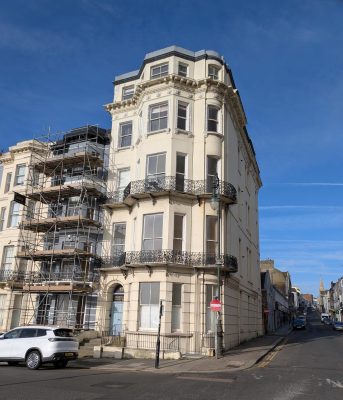
There was a planning application for a vault on the premises, which was approved 7 June 1867 as DH/C/6/1/1048, and is available at The Keep. As usual I have not looked at it — it is at The Keep, in Brighton.
The Hastings & St Leonards News, 3 May 1867, had a brief notice announcing the opening.
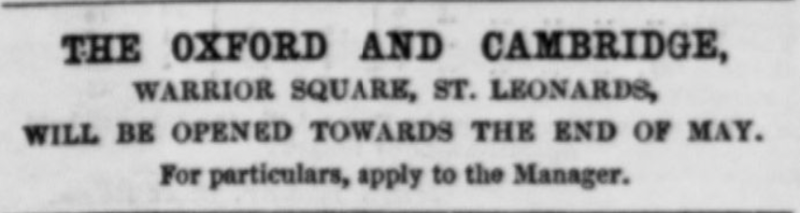
“THE OXFORD AND CAMBRIDGE,” Warrior square, we understand is to be opened next Thursday, by the usual English opening ceremonial; a dinner; at which the Mayor will preside. Tickets may be had of the Manager, at “The Oxford and Cambridge.”
Much more information is in the St Leonards & Hastings Gazette, 15 June 1867. Three ‘luxurious’ dinners were held, with the first one, with the Mayor, being for fifty persons. Two German bands, under Herr Kluckner and Herr Klee, played, and after the dinner a pianist accompanied two vocalists, all women. The building was described as superbly furnished. We at last had the name of the manager: Charles Fuggle. There were directors present as well.
The only local Charles Fuggle I could find was a music teacher in the 1871 census at 1 Market Terrace, close to Norman Road, age 47, born Maidstone; his mother Caroline, a widow, was a bootmaker employing two men, a woman, and a boy. Earlier, in the 1861 census, at the same address, both he and his father had been cordwainers (shoemakers). He sounds unlikely, but there is no other obvious candidate.
The festivities sounded very expensive, and it is not surprising that the hotel swiftly got into financial difficulties. A mere six weeks later, the Hastings & St Leonards News, 26 July 1867:
WE UNDERSTAND that the elegantly furnished mansion in Warrior square — the Oxford and Cambridge Hotel — is let to Mr W.H. Inman, from London, who has had great experience in the line.
Fuggle, the manager, was kept on by Inman. The same newspaper, 23 August 1867, gave his name on a (successful) application for an alcohol license. This was presumably for all three licenses: beer, wine and spirits — and probably, from the wording, only for consumption by those staying at, or perhaps also dining at, the hotel:
Charles Fuggle, Oxford and Cambridge, Warrior square, Mr Sheppard also supported this application, and stated that it was intended to keep the house as a private hotel, Mr Inman being the tenant.
The first advert for the hotel that I can trace was published in London in The Globe, 16 October 1867.
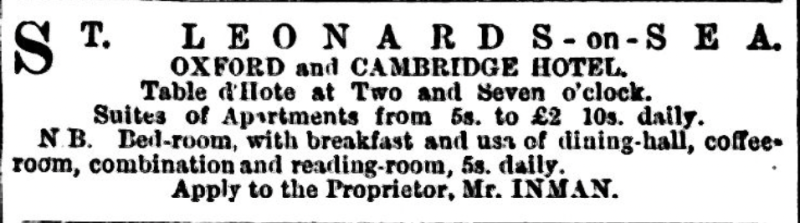
Apparently the hotel had been closed for a time when the first local advert that I can trace appeared, in the St Leonards & Hastings Gazette, 7 December 1867. The implication is that non-residents were being enticed to visit.
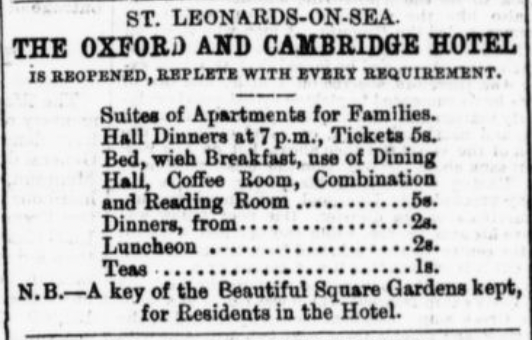
On the 22 June 1868 the Daily Telegraph & Courier had an advert by Mr Gausden, the local auctioneer, that the hotel would be put up for auction on the 2 July at the Castle Hotel. A fairly similar advert appeared in the Hastings & St Leonards News, 26 June. I do not know why the statement ‘no other house in the square can be opened or used as an hotel’ appears. The advert is, of course, enthusiastic about its value.
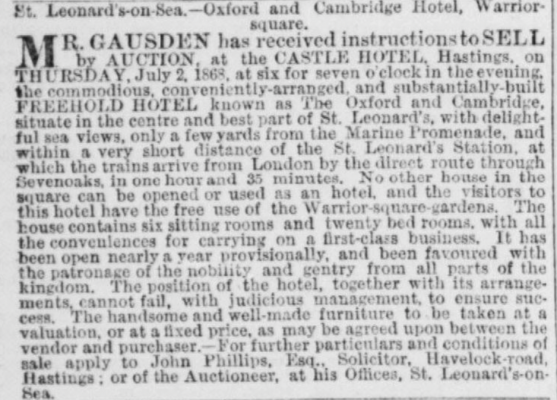
I could not trace the outcome of the auction. Duke’s bankruptcy proceedings stated that it did not sell. Adverts similar to that of the 7 December 1867 above continued to appear locally until at least November 1868.
The Hastings & St Leonards News, 5 February 1869, mentioned that among numerous actions pursuing bad debts in the County Court there was Philip Jackson v Rev. Robert Richard Duke for £13 5s 2d. Much worse was soon to come.
The London Gazette, 2 April 1869, announced officially the bankruptcy of the Rev. Duke, and also, in its customary listing of addresses (as also given below) provided the first link between him and the Oxford and Cambridge Hotel. More detail is given in the Hastings & St Leonards News, 2 April 1869, of the hearing at the Court of Bankruptcy, London, on the 24 March. Below is the complete transcript.
RE REV. R.R. DUKE
This was the first sitting for the proof of debts and trade assignees under the extensive failure of Robert Richard Duke (commonly known and called Robert Duke), described as “of No. 2A Berners street, Oxford street; previously of Terington, near Lynn, in the county of Norfolk; formerly of Lushington road, Eastbourne; prior thereto of Netherfield Parsonage, Battle, — part of the time having the Oxford and Cambridge Hotel, at Warrior square, St Leonards-on-Sea, all in the county of Sussex, private hotel proprietor and clerk in holy orders.”
Mr W. Ralph Buchanan, solicitor, 10 Basinghall st., and of Plumstead Common, Kent, filed the bankrupt’s petition on the 9th of March, and obtained for him protection from arrest until this sitting.
The lengthy preliminary list of creditors filed by the bankrupt extends over several large folio pages, and discloses debts due to unsecured debtors, £10,241 2s; and he states the cause of his bankruptcy to be as follows: “The house which I purchased at St Leonards-on-Sea not having realized my expectations as an hotel, and not having been successful in obtaining a purchaser for same.”
The numerous unsecured creditors of the bankrupt chiefly reside at Eastbourne, Hastings, St Leonards-on-Sea, Battle, and the west end of London; and the secured creditors are thus described: — Miss Mary Jane Day, gentlewoman, Bexhill, near Hastings, £1500, — “holds my I.O.U., dated about March, 1868;” Roger Duke, Esq., surgeon, Battle, Sussex, £1750, — “holds a mortgage on the freehold house, St Leonards-on-Sea, and the furniture therein, dated about August, 1867, to secure £1500; the said property is worth about £5000, subject to various mortgages;” Mrs Emily Duke, gentlewoman, Lushington lane, Eastbourne, Sussex, £2000, — “holds a mortgage on house and furniture mentioned against the debits of R. Duke, Esq., dated about June, 1867, to secure £2000;” A. Goddard, Esq., solicitor, Hailsham, £2000, — ” holds two mortgages for £1000 on freehold house situate at St Leonards-on-Sea, dated respectively in the years 1865 and 1866: the value of the property is about £5000;” Mr Lancaster, upholsterer, Hastings, £20, — “holds a quantity of household furniture;” Messrs. Rock and Son, coach-builders, Hastings, £30, — “holds a carriage value about £30;” James Watts, Esq., gentleman, Battle, £1500, — “holds a mortgage upon the house mentioned against the debts of creditors as above stated, to secure the re-payment of £1500, dated about June, 1867.”
At this sitting no creditor attended to prove, and therefore no choice of trade assignees took place, and the future proceedings will be conducted by Messrs. Aldridge and Sykes, the official solicitors, 46 Moorgate street.
The Court fixed the 6th of May next, at two o’clock, for the proof of debts and the bankrupt to appear before Mr Commissioner Winslow, and apply to pass his examination and for his order of discharge.
Upon the application of Mr W.R. Buchanan, renewed protection from arrest was granted the bankrupt, and the sitting terminated.
The sum due to unsecured debtors alone, £10,241, was equivalent to £1,073,000 today. The dates given for the mortgages are interesting, and all seem to relate to the same freehold property:
1865, A. Goddard, £1000
1866, A. Goddard, £1000
June 1867, James Watts, £1500
June 1867, Emily Duke, £2000 [his sister]
August 1867, Roger Duke, £1500 [his brother]
We can probably add the sum of £1500 from Mary Jane Day in March 1868. We are told that the property was worth £5000 (about half a million today), yet £7000, perhaps £8500 with Day, was borrowed against it. This was additional to the £10,241 due to unsecured creditors. His being a clergyman may have sufficed for a while to ease the fears of those who sold to him on credit, or made loans.
In addition, the mortgages going as far back as 1865 clearly predate the opening of the hotel in June 1867. This is significant, as the hearing on the 6 May stated that he had inherited £5000 in April 1867. Why was he securing loans on the house when he hadn’t bought it until January 1867 ?
The Eastbourne Gazette, 12 May 1869:
Mr Lawrence, for the creditors, asked for a cash account from the bankrupt, wishing to know how it was, with an income of £200 per annum holding a small preferment in Kent, and living in a quiet way, he had managed to get rid of £5000 left him at his mother’s death, in April, 1867, and how he got so largely in debt. In August 1867 the bankrupt borrowed £1600 from his brother; he also borrowed 2000 from his sister, and other sums, the creditors holding mortgages on the house and furniture. Mr Lawrence also accused bankrupt of appropriating certain goods which were supplied for a poor people’s clothing club, and Mr Duke should have handed over the money, but had not done so.
I was initially misled by the reference to April 1867 and thought that his mother died then. It actually meant that he obtained his £5000 inheritance then. She had died in December 1866.
A much longer account is in the Hastings & St Leonards News, 14 May 1869. The summary below is taken from it.
Mr Lawrance, for the creditors, said that there would be no assets for the unsecured creditors. He said that Duke had taken a house in Warrior Square and fitted it up as an hotel, ‘expending a very large sum of money upon it. There was a mortgage both on the house and furniture, and many of the debts contracted were of a very discreditable kind.’ The £5000 from his mother was the only amount paid to his bankers.
Mr Reed, speaking for Duke, said that his client had hoped that investing in property would pay him ‘a reasonable interest.’ He bought the building with a mortgage of £2000, and found that he needed to spend increasing amounts of money to improve and furnish it. Reed stated ‘he opened the hotel and kept it on himself for a fortnight; but not understanding the business he found that he was inundated with a mass of servants and and expenses, and he let the house to a person for thirteen weeks.’ This was W.H. Inman.
‘At the end of the time he requested the person to retire from the premises, but he would not do so, saying he had established a good business, and he filed a bill in Chancery against this gentleman. All this time the hotel was in this man’s possession Mr Duke could get no rent from him, and so to get him out, at any sacrifice, the suit was compromised, and the law expenses which Mr Duke had to pay came to £500. The tradesmen who had supplied goods then became clamorous for payment, and the end of it was that the pressure upon Mr Duke was so great that he was compelled to come to this court.’ He lamented Mr Lawrance’s remarks. The judge wanted accounts to be provided. Duke admitted that he was already overdrawn with his bank when he took the house. Proceedings were adjourned until the 24 June.
The Chancery case referred to is the National Archives’ C 16/504/I/J61 which is Inman v Duke, implying incorrectly that our clergyman was taken to court by Inman. I have not gone up to Kew to see it. Mathieson’s directory, 1867/68, gives Oxford and Cambridge Hotel as 15 Warrior Square, William H. Inman. As William Henry Inman he managed to get on the electoral roll for the property.
In the June hearing it came out that there were 73 unsecured creditors, and that he had spent £400 annually in the past two years. He owed £2655 to unsecured creditors and £7561 to secured creditors. These sums don’t add up to what was given before. Taking into account the value of the house he owed £5146. He wanted to be discharged, but ten creditors who were collectively owed £660 chose Joseph Arnold of Hastings, wine merchant, to be the ‘trade assignee’. I do not understand enough of bankruptcy law to make sense of it all. What is certain was that Duke had been naive and knew little about money management, and even less about hotels, and that Inman (whom I could not identify) was a rogue. This paragraph was drawn from the Hastings & St Leonards News, 23 July 1869, and the Bury and Norwich Post, 10 August 1869.
In the 1871 census, adding to what Venn tells us, he was living at the rectory of No Mans Heath, Warwickshire, as the curate, with the same sister Emily as in the 1851 census, widow, and four pupil boarders.
The Epsom Journal, 4 May 1880, told of the conviction of Duke at The Old Bailey for a “felonious assault on a young Frenchman, Louis Marot, a footman at Folkestone, and sentenced to be imprisoned for nine calendar months, in addition to the three months he has already spent in [Canterbury] prison”. Marot was in the service of a General Cannon. Duke had been charged at the Folkestone Police Court in January 1880, and had been in prison for three months awaiting trial. Incident in November 1879, Marot had confided in his master, and “General Cannon took steps for detecting the prisoner, who was arrested on the evening of January 19th on his attending at Folkestone to keep an appointment which Marot, by direction of the police, had made with him.” Correspondence between the two was part of the deception plan. He was the curate at Smarden, and both the Vicar of that parish and the Vicar of Pluckley (for whom he had also served as curate) attested to his morality and honourable conduct. The jury took half an hour to find him guilty. He was imprisoned at Newgate for what the Prison Commission Records described as ‘indecent assault on a male person.’
In the April 1881 census Robert was lodging in Kentish Town, a clergyman Church of England, still with loyal sister Emily. She died in 1890 in Enfield, age 72, with Robert the executor to her estate of £914. In the 1891 census he was living in Chipping Barnet, ‘clerk in holy orders.’ Robert Richard Duke died 13 November 1900 in Devon, age 69, and did not leave a will.
What happened later to 15 Warrior Square ? I have not researched this in detail, but we get a little information on the premises in the 28 August 1880 edition of the Hastings & St Leonards Times. This reported on a full alcohol license application for William Gifford’s hotel at 15 Warrior Square. He paid £200 p.a. in rent, and had 21 bedrooms and 5 sitting rooms. He had the space to apportion two rooms off for the public, and ‘He knew that five years ago the house was licensed as the “Oxford and Cambridge”.’
In 1912 the building was converted into flats with planning application DH/C/6/1/8146. It seems to have been known as the Clarendon Hotel at the time.
I can confirm that Charles Fuggle was indeed a local musician and music teacher as well as a shoemaker of 1 Market Street, St Leonards He had been organist at Netherfield church where he first encountered Robert Duke who was the vicar at the time and from thence was recruited to manage the hotel along with his mother Caroline. I have further details of Charles Fuggle who was my 2x great grand uncle and of course Caroline (Nee Inskip) was my 3x great grand mother.
Tony, that’s really interesting, thanks