

I recently watched on YouTube ‘The flirtatious Regency balls of Pride and Prejudice: having a ball’, an amusing attempt to recreate Mr Bingley’s private ball at Netherfield in Jane Austen’s Pride and Prejudice. Balls provided a rare way for young people to flirt, chat, and touch each other without close supervision while dancing.
It made me think of the Bachelors’ Balls held at the Assembly Rooms at St Leonards. I have read many accounts in the newspapers of these annual events, and this post is a summary of how they appear to have been conducted. Sometimes the newspapers referred to it as the Bachelor’s Ball, but this would imply that one bachelor held it.
We are fortunate that Mr Brett, the St Leonards chronicler, in his own St Leonards and Hastings Gazette, 31 December 1892, stated that the first was held in 1830, ‘attended by 170 persons, and that the company expressed great satisfaction at the catering of Mr and Mrs Hodgson.’ They were running the Royal Victoria Hotel.
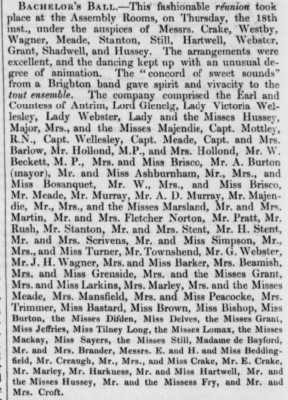
The earliest contemporary newspaper description of the Bachelors’ Ball that I am aware of is in the Hastings and St Leonards News, 26 January 1849. It was held at the Assembly Rooms on Thursday 18 January and was described as a ‘fashionable reunion.’
Alfred Burton, the mayor, was one of those attending the 1849 ball. Despite its name, besides bachelors and young single women there were usually parents, at least of the ladies, perhaps as chaperones, and probably talking and eating rather than dancing. I deduced this from the frequent lists of guests. It appears that as the years went on some married couples were invited without any children.
The balls appear to have normally started at 9.30. Dancing began at 10. Supper as a cold buffet, catered by local traders, was provided at midnight in the reading room. Dancing continued until 3 or 4 in the morning. The bands were usually from London or Brighton, and at least once from Tunbridge Wells. There is no mention of any other hired staff being present that I could see.
It is important to make a distinction. Typically there were public dances, which were open to any who paid for a ticket. In 1857 the newspapers briefly mentioned a ball to be held at the Saxon Shades for a shilling [3 London Road, later named the Yorkshire Grey, then the Admiral Benbow], and tradesmen occasionally staged their own balls, perhaps limited to workmen. More expensive, but apparently open to all who could afford it, was the Battle Subscription Ball, to take place at the Drill Hall at Battle on the 27 December 1871. Despite the word ‘subscription’ tickets were available at a cost of 12s 6d to attend (about £64 in today’s money), with applications being made to one of the six members of the committee of management. This included local names like Crake and Brassey, and so the ball was not just for Battle residents (Hastings & St Leonards Advertiser, 14 December 1871). Similarly, the Queen’s Head Hotel at Hawkhurst had a ball on the 28 December 1852, for which tickets were 6s for ladies and 8s for gentlemen.
The same page as the 1871 citation had a brief mention of the annual Christmas ball at the Assembly Rooms but without a named price. This event is a little mysterious, as it was clearly for the gentry of the district, but it was mentioned as a subscription ball in 1832, so probably it worked along the same principles as the Battle ball, perhaps with some discreet screening by the committee. The St Leonards Christmas Ball on the 26 December 1855 at the Assembly Rooms cost 6s, with tickets available at Southall’s Library in St Leonards or Diplock’s Library at Hastings rather than from a committee. On at least two occasions profits of £3 to £5 were donated to a hospital.
Then there were the more prestigious private dances, such as at Netherfield. No worries about awkward encounters with tradesmen ! In St Leonards these typically would have thirty or fifty people crammed into the main room of a fine house on Marina or close to the St Leonards Gardens. This may sound crowded, and in practice some probably did not dance, or sat out some of the dances to relieve the pressure on the dance floor. The contemporary newspapers frequently gave brief reports on such private occasions, sometimes listing those attending. They were of course paid for by the hosts.
The bachelors’ balls were I suspect a mixture of these two. As we shall see, in 1863 the ball was described as ‘semi-private’ because of the large numbers attending, although in 1858 it had been called a private party. Invitations were sent out to the ‘elite’ of St Leonards and its neighbourhood from a (sometimes named) committee of gentlemen from the Hastings and St Leonards Gentlemen’s Club. The 1859 report states that it was conducted by the bachelors connected with that club. The report on the 1868 ball implies that this club habitually used the smaller rooms of the Assembly Rooms, which were also used for the balls. In order to attend, surely money must have somehow changed hands. Perhaps they were like hen parties in exotic places where the hostess ‘asks’ for a contribution. I would be interested in any comments offering evidence either way. Somehow the balls had to be paid for ! Brett in his manuscript history for 1857 has this vague statement: ‘After all the expenses of the ball had been met – which must have been very considerable – a surplus was left, and given over to the funds of the Infirmary.’
The 1868 ball, as reported in the Hastings & St Leonards News, 17 January 1868, listed sixteen committee members (one being Decimus Burton) who ‘issued’ nearly 300 invitations. It is not clear if this was to individuals or households. Winter was the social season, and it is probable that many of those invited were those who stayed for much or all of the winter, in rented houses, lodging houses, or hotels, as well as permanent residents. This was because winter in the countryside could be dreary, while London’s coal fires caused smog, and would encourage decamping to towns outside the metropolis (although in London, too, the winter was the social season). The small size of St Leonards, and the frequent breezes, would have meant little smog, with the prevailing southwestern wind blowing the smoke away towards Hastings. It also accounts for western districts of London such as Kensington being more fashionable than the East End. Hilly neighbourhoods such as Hampstead also benefited, as most of the smog stayed below.
Still with the 1868 ball, decorations in the main room consisted of numerous naval flags with wreaths of evergreens and flowers and stars of defensive weapons. ‘When fully lit up, the effect was most striking.’ The St Leonards & Hastings Gazette the next day added that the doors of the smaller rooms were temporarily removed, and that the coastguardsmen put up the decorations under the supervision of Captain Downes.
What about the music ? Brett stated that the 1847 ball was the first with a London band. The St Leonards and Hastings Gazette, 6 February 1859, stated that the music was supplied by Messrs. Tinney and Coote of Conduit Street, London. This band consisted of ‘violin, flugelot, cornopean, harp, piano and double bass.’ There were thirty dances, including ‘the Ernani, Palermo, Martha, and Les Dames d’honneur quadrilles’, waltzes, polkas and gallops. It is a wonder that the participants apparently knew all the dances !
The report on the 1878 ball, as reported in the Hastings and St Leonards News,15 November 1878, did not list the dances, to music from Gates’ band from Brighton, but stated that they consisted of ten waltzes, three lancers, six polkas, one schottische, and two galops: twenty-two in all.
An example of one account of the ball, with a rare female caterer, is in the Hastings and St Leonards News, 23 January 1863:
Through the later hours of Wednesday evening, the streets of the west portion of the borough were quite alive with the rattling of numerous vehicles, which were conveying to the St Leonards Assembly Room the beauty and fashion of the town and neighbourhood. The attraction was that fashionable assembly known as the Bachelor’s Ball, — one of the most popular dance-gatherings of the season. Though of a semi-private character, the extent to which invitations are issued gives this assembly public interest. The arrangements are made by a ball committee, mostly members of the St Leonards Club. The gentlemen in whose names the invitations went forth were D. North, Esq., C.J. Norris, Esq., J. Coventry, Esq., and H. Brassey, Esq. With them we believe were associated in the management Messrs. Westcarr, Sutherland, H.G. St Paul, and Mossop, and Capt. Poynter.
The arrangements were similar to those repeatedly recorded in our columns on former occasions. A detachment from Messrs. Coote and Tinney’s band (London) occupied the orchestra, and the brilliant company was kept engaged in quadrille, valse, &c., to the strains of these talented musicians with brief intervals until after three o’clock. At twelve o’clock supper was served in the club reading room, this department having been entrusted to Miss Lock, of George street (the late Mr Vickery’s successor).
Either the balls ceased or they were no longer reported after 1879.