

In the 1891 census at Deptford, Kent, Elvey Thomas was a 14-year-old clerk, born New Cross, his father a railway official.
The Hastings and St Leonards Advertiser, 21 April 1898, announced that he had been appointed manager of the St Leonards Pier. He was only 21 ! As on this occasion, he was consistently described in the newspapers as courteous, popular, and respected.
The pier had been built in 1891, a short distance to the west of the Royal Victoria Hotel. The planning application for its pavilion was approved on the 1 January 1891 as DH/C/6/1/5052. What was left of the pier was pulled down in the early 1950s. Like the rival Hastings pier there were numerous activities, as well as theatrical and musical events, to encourage visitors. This included Elvey encouraging fishing off the pier. It’s a big subject, so this account will only give an idea of the numerous activities carried on it while Elvey was in charge.
The Engineer, 11 May 1888, has many engineering details for the ‘promenade pier’ including on page 384 a plan from above of the pier layout and front and side elevations of the pavilion as envisaged at the time by R. St George Moore, the designer. The article stated that work was beginning on the pier’s construction.
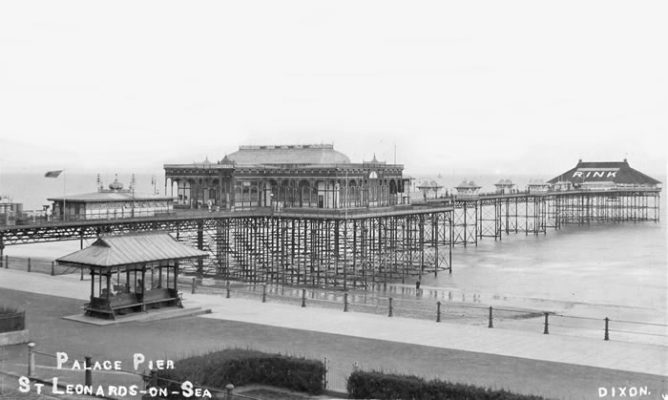
Numerous images of the pier are on the Historical Hastings website’s St Leonards Pier page. These show it at different times — its appearance changed with modifications — and in close-ups and from the air. It was hard to choose just one, which is given below and is dated 1909 or later when it became the American Palace Pier. The large pavilion for theatre and music close to the shore in the photo below was placed there to provide easy access for those arriving by carriages. The pavilion at the far end was originally the location of a covered area where a band could play. The pier only used a little advertising. Travelling troupes and their shows were regularly written up with enthusiasm in the Hastings Observer, with farces appearing to be much favoured.
An early mention of Elvey was in the Hastings and St Leonards News, 23 July 1898. He said he was of 26 Alexandra Street when giving testimony in a case. A lady had complained to him at 8.15 am that she had lost her purse, and described two men of whom she was suspicious. Thomas had seen the men leave the pier and told his assistant, Crouch, who followed them together with the lady and her husband. The result was that the two men, who admitted previous convictions, each received a sentence of three months’ hard labour.
Besides being the manager, Elvey took on some acting roles on the pier. For example he had a minor part in a comedy drama titled The white feather, set in the 2nd Anglo-Boer War (The Hastings and St Leonards News, 21 April 1900).
From September 1900 until at least 1907 there were annual benefit concerts for Elvey. I would have thought that benefits were for retirements or to mark significant milestones. Perhaps those offering their services for free were doing so in the hope of securing bookings ? In 1901 he was initiated as a freemason at the local Derwent Lodge, and he played a significant role in their activities for many years.
There was a takeover in 1909, as explained in the Hastings Observer, 13 March 1909:
Yesterday (Friday) the details of an important scheme which will revolutionise what is now the St Leonards Pier, were communicated to the “Observer.”
Mr H.F. Blackwell, the Manager of the Rinkeries Company (the American Syndicate which has transformed the Royal Concert Hall into the American Roller Skating Palace), and Mr Elvey Thomas, Manager of St Leonards Pier, went to London on Thursday and carried out negotiations for the taking over of St Leonards Pier for a term of years. The Pier is in future to be called the American Palace Pier, and the intention of the Syndicate is to build it on the lines of their best Piers in America, at Atlantic City, New Jersey, where there are three. Before the erection of these Piers Atlantic City had a floating population of 75,000. Now the population has risen to a million.
It is intended to build a LARGE OPEN-AIR PAVILION (i.e., with a roof, but with open sides, having protection in rough weather), which will be run as an open-air roller skating rink. There will be a new floor, of the same class as at the American Roller Skating Palace, but about twice the size. A number of kiosks will be let for attractions, such as bowling alleys, shooting and photographic galleries, novelties and souvenirs, sweetshops, fruitshops, and so forth. The present pavilion will be retained, but enlarged, for animated pictures and varieties, and to give townspeople and visitors a very select dancing hall, “which,” said Mr Blackwell, “is very much wanted in this town at present.”
A temporary stage, somewhere about the centre of the Pier, will afford facilities for leading novelties and attractions, such as tight rope walkers, high diving, bicycle acts, and high-class novelties of all descriptions, free, afternoon and evening, to those who pay the ordinary toll to the Pier. A large military band will play high-class music free.
A magnificent display of electric lights – about 8,000 – in red, white and blue, and with electric signs, will form an illumination all round the Pier, and an electric sign in letters four about feet long will be visible from Hastings…
Three planning applications followed, which are stored at The Keep, Falmer. DH/C/6/1/7766 was approved on the 21 May 1909. The Hastings Observer, 22 May 1909, described it as follows:
Alterations and additions at St Leonards Pier, new pay boxes, bowling alley, and shooting gallery, new vestibule to pavilion, skating rink pavilion; the American Rinkeries, Ltd., owners; Messrs. Chas. A. Pigott and Oxley, architects
There were restrictions imposed such as the buildings being temporary other than the [roller] skating rink pavilion.
DH/C/6/1/7778 was approved on the 4 June 1909. The Hastings Observer the next day described it as
Details for iron arch and railings at entrance to the St Leonards Pier; The American Rinkeries, Ltd., owners; Messrs. Pigott and Oxley, architects.
Finally there was DH/C/6/1/7781, approved 18 June 1909, which was described the next day as follows:
Amended plan for bowling alley at the St Leonards Pier; the American Rinkeries, Ltd., owners; Messrs. Pigott and Oxley, architects (to stand for a period of five years from the 21st May, 1909).
In the 1911 census Elvey was at a boarding house at 13 West Hill [Road], age 34, born New Cross, pier manager.
Elvey married on the 1 November 1913 at St Leonards Church. The marriage certificate stated that he was age 36, bachelor, pier manager, of 53 London Road, son of William, gent. His bride was Emily Black, widow, of 25 St Saviour’s Road, daughter of Matthew Borton, gent. In the 1881 census at Oxford her father was a widowed college servant with five children – a ‘scout’ who looked after undergraduates’ rooms. The photo below shows Elvey with a moustache next to his bride with her large hat and bouquet.

Emily had married in about 1900, in Lancashire, James Norman Black. In the 1911 census they were boarding at 2 Carlisle Parade, Hastings, he 51, private means, born Java, she 45, born Shalstone, Bucks. He died on the 24 August 1912 at 25 St Saviour’s Road, St Leonards.
When World War I started in August 1914 Elvey became increasingly involved in the war effort. He was reported ensuring that any soldier attending evening concerts received cigarettes free of charge (Hastings Observer, 12 December 1914). Many soldiers were billetted in the town while undergoing training.
Elvey was a Special Constable on duty when, in the same, 9 January 1915, he gave evidence in a case before the magistrates. Winifred Ivy Banks was charged with being drunk and disorderly on Marina.
His attention was called to prisoner shouting and behaving in a disorderly way on the beach near the Pier. He asked what was the matter. She told him a soldier had threatened to stab her and throw her body in the sea, and that he had taken her purse. As she was under the influence of drink, witness took her to the police station.
PS Wilkinson said that she had been drinking with soldiers, and had freely given one her purse. She was fined 5s and costs.
In the Hastings and St Leonards Pictorial Advertiser, 14 October 1915, Elvey was welcomed back from a lengthy trip in the North Sea on government business. He was named as a director and major shareholder in the pier. In his obituary he was said to have been superintendent of shipping for two years for the British Government at Dunkirk and Antwerp. It was hinted that his prolonged absence had cost him his job.
Nevertheless, in 1916 the newspapers called him the managing director, while the acting manager was Edward Van Biene, who I wrote about in The Van Biene family.
In November 1916 the newspaper reported that the St Leonards Pier appeared to be having problems as the [Hastings] Corporation was providing a Winter Orchestra to Hastings Pier. There were grumbles that the eastern portion of the town was being favoured. Despite the presence of soldiers, the war must have caused many problems for the leisure industry.
According to his obituary he left the pier in 1917 when he owned it with an accountant partner. If so, I am not clear about what had happened to the role of the American backers. Certainly, in August 1917 a Mr John Henry Gardner moved to St Leonards and took over the pier. He became well known for his generous support for local charities and his attempts to make the pier a success.
But although the St Leonards Pier was an important attraction, it was an ongoing financial failure. Gardner effectively went bust in 1927 and offered the pier to Hastings Council for a mere £9,000. This was refused, and the pier’s decline continued. In World War II both piers had spans removed near the land end as a precaution in case the Germans tried to use them in an invasion.
I don’t know what Elvey did over the next few years, but the 1921 census, for a five-roomed flat at 116 Marina, St Leonards, provides a little information:
Elvey Thomas, 44, married, born New Cross London, Pier Manager (Navy), out of work
Emily Thomas, 55, married, born Shalstone Bucks
You were required in this census to name your last job if unemployed, and the navy mention was perhaps the shipping management role. It is possible that the couple owned the building and were renting the other flats out, but if so I would expect his role as a landlord to be mentioned. Perhaps they were relying on savings.
The Hastings Observer, 3 March 1923, announced that the license of the White Hart had been transferred from William Rayner to Elvey Thomas. This pub, at 54 Norman Road, was halfway between London Road and Mercatoria, on the south side, next to an alley. I have not researched its history in detail, but here are a few anecdotes about it before Elvey took over.
Rather tantalising — because I have not ordered copies — is the fact that the Kent History and Library Centre at Maidstone holds, among its Leney brewery archives, EK/U933/T24, which is catalogued as material for 1851-88 relating to the White Hart, including plans of the pub for 1851 and 1874. In my experience such plans are very unusual. 1851 also predates the listing of Charles Foord as the first licensee, 1856-88, in David Russell’s Register of Licensees for Hastings & St Leonards.
The Hastings and St Leonards News, 25 February 1853, contains a bizarre letter to the local police inspector by John Jones, of Leeds. His address was Bucks County Prison, Aylesbury. He wrote that in April 1852 he had been sentenced to four months at Lewes for robbing Henry Picknel, at the ‘sign of the White Hart, Norman Road West’. He was now hoping to be transported to ‘the diggings’, that is, Victoria, Australia, where a gold rush was in full swing. He was hoping that Hastings would support this ! The newspaper account ended with
In this, however, he will be disappointed, inasmuch as the government have stopped, or are about to stop, all further transportation to that enviable region.
The Victorian government had passed the Convicts Prevention Act 1852 to prevent former convicts from entering. Transportation to Victoria itself was not possible either as it had become a free colony in 1850.
Picknel was the publican rather than a customer, as the Hastings and St Leonards News, 2 April 1852, referred to Henry Picknell as a beer-shop keeper on Norman Road. This was the account of the theft by the same Jones, aged 33, shoemaker, of a pilot jacket worth ten shillings. On a Saturday afternoon Picknel(l) had been asleep in his bed on the top floor when he was woken by Jones grabbing the jacket off the bed. All the doors were open although they had been closed a little while before, suggesting Jones had been looking for loot. Jones claimed he only wanted to look at the jacket. Hester Watson, the servant, and her unnamed mistress were also mentioned. Sadly, the newspapers also mention the death of Henry’s wife Mary a month later, on the 3 May 1852. I did not find any evidence in the 1851 census of a beerhouse on Norman Road (whose numeration repeatedly changed). In the same census the Picknel(l)s were probably the couple at Stoke by Guildford, Surrey, he a tailor, born Hastings.
The Hastings Observer, 26 October 1872, reported on the publican, Charles Foord, being charged with opening his licensed house, the White Hart, St Leonards, on Sunday at 8.40 am. Harriet Lansdell, aged 60, took home a jug of beer, which was supplied by a boy. This was said to be inadvertent. Foord was fined 5s. and costs.
Below is an advert for an auction in 1872 for the freehold of the White Hart and nearby properties at the nearby Warrior’s Gate, now rebuilt as the post office on London Road. There were two bars, and four bedrooms and two sitting rooms on the two floors above. J. Foord rather than the actual Charles Foord was named as the occupier.

The Hastings and St Leonards News, 16 April 1886, reported on another case. Frederick Breach, cabman, the defendant, had taken a Mr Thomas to and from Silverhill, where the passenger paid, and they later returned to the White Hart. On their arrival, there was a quarrel and ‘defendant hit him on the nose, and knocked him up into the road.’ In his defence Breach said his passenger was ‘beastly drunk’, and that he had been challenged to a fight. The cabman was fined 5s. and costs.
In 1894 there was planning application DH/C/6/1/5579 for ‘Alterations’.
The 1911 census was the first where the number of rooms occupied by each household was stated. The White Hart had six rooms (this only counted the rooms above the actual bar areas). The occupants were Jane Ann Youens, age 59, widow, licensed victualler, born Brighton, and her daughter Sarah Jane, 37, born Middlesex, whose job was to ‘assist in bar’. Jane was the widow of Alfred, a leather salesman who had become a victualler by his death in 1886 in Ashford.
The 1921 census only cited five rooms. The occupants were William Rayner, 53, innkeeper, born Sudbury, Suffolk, and his wife Emmie Louise, 47, born Lambeth, Surrey, who was assisting in the business. He had been a ‘licensed victualler’s manager’ when they married in Battersea in 1896.
So, back to Elvey in 1923 taking over the White Hart.
In 1928 the Hastings Observer had a great deal of information in reporting on efforts to close the White Hart. Under a compensation arrangement that began with the Licensing Act 1904, there were attempts to reduce the number of licensed premises to avoid possible problems such as crime for those struggling to make a living. Compensation, which mostly went to the owners (typically breweries) rather than the publicans was financed by levies on all licensed premises rather than by taxation.
Arguments were made before the magistrates in the 10 March 1928 edition about why the White Hart should not have its licence renewed. Mr Glenister was to speak for both Elvey and for the owners, brewers Messrs. Leney and Co., of Dover. The Chief Constable said that
It was a comparatively small house with three bars. There were eleven licensed premises within 150 yards [this was probably misheard, see the figures below in the November report]. It was doing less trade so far as the police were concerned that any other house in that area. Inspector Philpot found an average of 4.71 persons per visit. In the Foresters (Shepherd-street) he found an average of 8.29 persons. In other houses he found greater numbers, reaching a maximum average of 24.75 in the Yorkshire Grey in London-road [Later named the Admiral Benbow, and now the Benbow Arts Space].
Supt. French gave particulars of the house, and said he had known it to have a modest trade for many years.
Mr Glenister: A modest trade, but a very good class one ! – I should say so.
Inspector Philpot said he had paid 32 visits during the last 13 months; 18 of them in the last two months. He found 131 people, an average of 4.71 per visit. In the Yorkshire Grey he found 792 people; in the Horse and Groom 409 people; in the Nag’s Head 330 people; in the Foresters 252 people; in the Warrior Gate [badly damaged in World War II, since rebuilt as the post office on London Road] 667 people; in the Norman Hotel [now the Piper] 501 people; and in the Old England 552 people. There would be ample accommodation if the house were extinguished.
In answer to Mr Glenister, witness agreed there was nice but limited accommodation.
Mr Glenister reminded the Bench that Mr Elvey Thomas was manager and partner of St Leonards Pier a few years ago. He pointed out that the magistrates had just decided to take away the licence of a house at the top of the list, as regards trade; now they were asked to take away the licence of one at the bottom. He pointed out that the majority of the beer sold was of the better quality, yielding a higher profit. To find four or five people always in a house, going in haphazard at any time of the day, showed a good trade, it was no indication that the house was not wanted.
The licensee, after being manager of St Leonards Pier for 20 years, went into the Navy during the war and afterwards as Marine Representative of the Ministry of Shipping at Dunkirk and Antwerp. For two years after returning he had been unable to find a living; then in 1923 he took this house, and was now earning a comfortable living there. Mr Glenister went on to argue that many people welcomed the idea of a small quiet house, where they could find comfort. Everyone did not want to be crowded among 24 people in a “four-ale” bar.
Mr Elvey Thomas, on oath, said he was perfectly satisfied with the living and the class of trade he did. His customers were commercial travellers, good class trades people and visitors. It was a free house for wines and spirits.
Mr Glenister submitted trading accounts for the house.
The Chief Constable: You will agree that there are too many public houses in that part of St Leonards ? – Plenty of room for one or two more, sir.
Alexander Clare Adams, Hastings manager to Messrs. Alfred Leney and Co., of Dover, said the trading account for the house showed 73 per cent, 81 per cent, and 86 per cent average of the better beers during the last three years. The better beers were usually sold in the less frequented houses. The White Hart was the only tied house the brewers had in St Leonards. There was not another nearer than the Old Town. There had only been one change of tenant in 12 ½ years. Mr Thomas was a satisfactory tenant and his trade was increasing. In the last five months there had been a nine-barrel increase compared with the corresponding period of the previous year. The brewers had spent £86 last year in decoration and repairs and £209 18s in the last ten years.
The house was referred for compensation, as stated.
I did not find evidence for the claim that Elvey had served in the Navy.
A second hearing was reported on in the 3 November 1928 issue, when Glenister spoke before the Compensation Committee to argue that the White Hart should not be closed.
After discussions of the Pilot, on Queen’s Road, which was reprieved, followed what was headed FOR THE QUIET MAN.
Mr Morgan, for the licensing authorities, said that after police visits the White Hart was found to have the lowest number of customers of a dozen in the vicinity, 4.7. He said that there were eleven houses within 350 yards, six within 200 yards, and three within 120 yards [these would have been the Horse and Groom, the Nag’s Head, and the Warrior Gate, now the site of the post office]. The report went on:
The licensee, Mr Elvey Thomas, was a very well-known man, and of course there was not the slightest suggestion against his character.
Police evidence in support of the figures quoted as to the custom of the house was called.
Mr Leney (of Leney and Co., Dover), said the trade was 300 barrels a year, and it consisted mainly of the better class of bottled beer. The firm had no other house selling such a high percentage of 7d and 8d beer. It was their only house in St Leonards, and a house doing a trade of 300 barrels yearly was certainly not redundant.
Mr Morgan: — There are other houses near where people can get good bottled beer ?
Mr Leney: — I don’t know about that. They can’t get our beer.
The Clerk: — You think there is no beer like Leney’s ?
Mr Leney: — I am positive of it ! (Laughter.)
Mr Glenister submitted that there was no evidence that there were too many houses in the district; the only argument was that the house was doing such a bad trade. Surely it was not a desirable policy to crowd more people into houses that were already crowded out. This house did a particular trade, for a particular class of person. Obviously it was a quiet, orderly house, just what the quiet respectable man would go into for a short time. The customers were not the kind who drank pints and pints of cheap beer and sent up the barrelage. The trade of the house was equivalent to six barrels a week, and that was a high trade. If the house were closed, Mr Elvey Thomas would pick up a few hundred pounds, but what compensation was that to a man between 50 and 60 years old, for the fact that he had lost a job which he made for himself when he came back from the war ?
The magistrates conferred briefly, and the Chairman announced: “In this case also we shall renew the licence.”
Elvey’s wife Emily died in 1933 while on holiday at Caversham, near Reading.
On the 30 September 1939 the ‘Register’ of all civilians in the country in street number order gave for 54 Norman Road, as its only resident:
Thomas Elvey born 11 Dec 76 Widower lic vict.
There was an interesting account of a theft at the White Hart in the Hastings Observer, 5 December 1942:
Officer as Interpreter. BAG-SNATCHING CHARGE. An officer from his unit acted as interpreter when Gunner Cyrice Paradis, described as a French Canadian, was charged at Hastings Police Court on Thursday with stealing at 9.35 the previous evening, from the White Hart Hotel, Norman-road, St Leonards, a lady’s handbag and contents, the property of Mabel Dorothy Philpott.
War Reserve Morris said at 9.45 the previous evening he was at the bottom of London-road when he received a complaint from Mrs Philpott. As a result he obtained a bicycle from a passing cyclist and rode towards Marina. When opposite No. 66, Marina, he saw Paradis walking in a westerly direction. As witness rode up to him Paradis started to run. Witness dismounted and gave chase and caught him outside No. 93.
Witness told him he answered the description of a Canadian soldier who snatched a handbag from underneath a lady’s arm in a public house at St Leonards, a few minutes before. He made a reply which witness could not understand. Witness took him back to London-road where they met Mrs Philpott who flashed a torch on Paradis and said: “You are the man: where is my handbag ?” Paradis was taken to the Central Police Station and charged.
On that evidence, Inspector Knell asked for a remand for 14 days and offered no objection to bail.
Paradis was remanded and allowed bail in a personal surety of £5 and one surety for a similar amount. The officer who acted as interpreter was accepted as surety.
The 19 December edition added some more details, and cited Elvey as a witness stating that he saw a soldier arguing with Mrs Philpott. Elvey said he found the bag, half open, on the mat outside his front door the next morning. It had contained banknotes and war savings certificates to the value of £17. In the end, as Paradis had no previous convictions and the officer interpreter said he had a ‘good Army character’, he was fined 40s.
Planning application DH/C/40/52/516, approved 26 September 1952, was for a W.C.
The Hastings Observer, 20 June 1953, contained a letter by Elvey stating that he had been in the Royal East Sussex hospital for eight weeks. He had had excellent treatment, and he praised the staff. ‘Nothing was too much trouble. Beside that, the food was excellent and left nothing to be desired.’ It was ‘an admirable home from home.’ He gave his address as the White Hart Hotel.
Elvey Thomas died on the 26 June 1953, aged 76.
His obituary in the 27 June 1953 edition described him as of a ‘jovial and kindly disposition’, and liked by all who knew him. His death would be deeply regretted by his many friends, especially in masonic circles. The 4 July edition described his funeral at Hastings Cemetery, with much mention of masonry. The service was conducted by the Rev. R.A. Leonard, Vicar of Westfield, who was also the Chaplain of the Derwent Lodge, and gave the eulogy. Elvey was described as past Worshipful Master of the Derwent and Senlac lodges. At the close of the service the attending masons ‘sang their closing hymn, and dropped their traditional sprigs of acacia into the grave.’
The Compensation Authority eventually got its way as briefly reported in the Hastings Observer, 11 July 1953. Their intention to meet to discuss the White Hart’s closure had been announced in a notice while Elvey was still alive, in the 13 June edition. They decided that the licence for the White Hart was ‘redundant’, and ordered that it be closed seven days after compensation had been paid. Mr Glenister, acting for the executors, suggested that it be closed immediately, and this was agreed to. Formal notices asking for claims to the (unspecified) compensation money appeared in the newspaper on the 1 August 1953, revealing that proceedings were under the Licensing (Compensation) Act 1910, and that while Leney’s owned the premises, Fremlins, a Maidstone brewery, held the lease.
The Hastings Observer, 4 December 1954, announced that the freehold premises would be sold by auction in January, with vacant possession. It was described as a shop with seven rooms over. However, the 24 December edition offered it for an ‘upset price’ of £1000, while stating that it required modernising and redecoration.
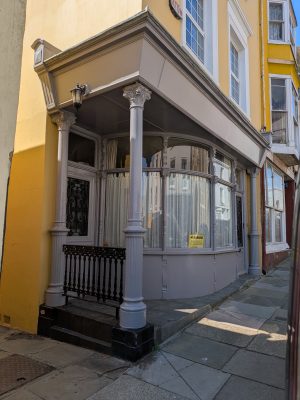
A planning application in 1955 was for a change of use from a public house to a restaurant with living accommodation, and another in 1995 was from shop to residential. It is now a private house.