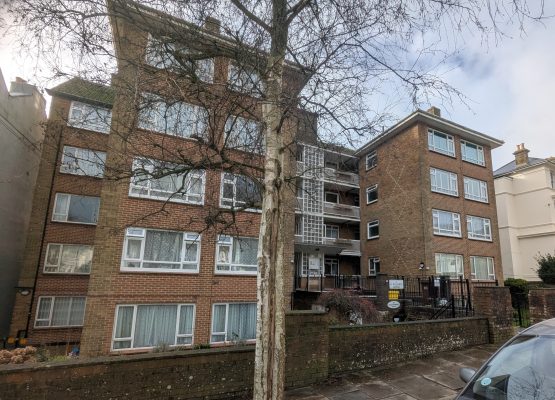

Recently I noticed houses in Union and Alfred Street with niches in their walls, as if for statues of saints, and wondered about them. They are at nos. 8 and 17 Alfred Street and 5 Union Street. By chance I came across an article in a 1936 newspaper which made clear why they are there.
The 23 March 1935 issue of the Hastings and St Leonards Observer (further citations to this newspaper are simply ‘issue’) explained about the foundation of the Christ Church St Leonards House Improvement Society. It was to be chaired by the parish rector, the Rev. G.R. Vernon, and was believed to be the first such effort in a single parish. The Rev. Vernon had experience from a similar effort in the St Pancras neighbourhood of London. He was quoted as saying “There are some very bad parts in our parish. Most people if they ever hear of Christ Church always think of us as a very fashionable parish with plenty of money, as though the whole of the congregation had £2000 a year, but there are some very bad parts in the parish.”
He described the conditions prevailing in some houses he had visited. There was not so much overcrowding as there had been, but he could take them to a house which had four rooms – each five feet square – in which lived a family of seven. There were families living underground who were forced to use artificial light in the height of summer. The aim was to recondition and perhaps build from new. The buying of shares at £1 each was encouraged. The various newspaper references make it clear that dividends were limited to a maximum of 2.5% as the aim was to provide affordable, decent housing rather than a high return for shareholders. There were frequent pleas for more shareholders. The citations also make it clear that the parish church’s leadership believed in a strong obligation to help the neighbourhood’s needy, regardless of faith.
The rector was Gerald Vernon (1899-1963), who served the parish until 1940 when he became the Bishop of Madagascar.
The first project was 5 Union Street. This is at its northwest corner, with Alfred Street forming the other side. Until 1924 it was the Duke of York public house. A planning application for ‘Alterations’ was rejected on the 9 November 1935 and is at The Keep as DH/C/6/1/12827, but a revised application was approved on the 10 January 1936 as DH/C/6/1/12884. As is my custom I have not looked at either of them: they would of course show plans of the interior. Newspaper mentions of the applications state that the architects were Messrs. H. Ward, Son and Wray.
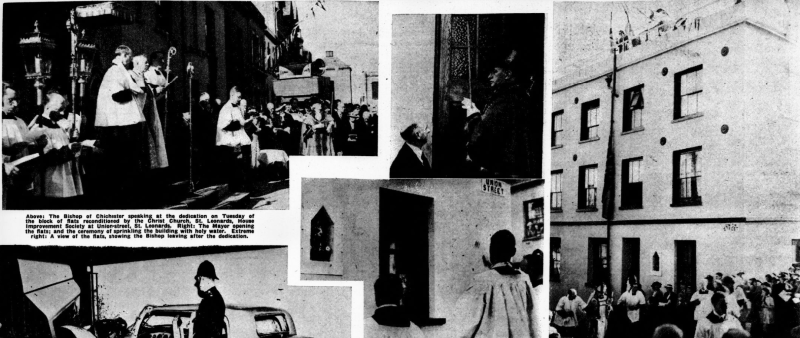
The Hastings Observer, 23 May 1936, reported on the opening of the (five) flats by the Mayor, the Bishop of Chichester (Dr Bell), and other dignitaries. Many people watched the ceremony from nearby rooftops. Afterwards there was a return to Christ Church where the Te Deum was sung. Below is a montage of photos, in the same issue, which were taken on the occasion. They show the niche which is still there at 5 Union Street.
The 16 May issue had earlier commented on the scheme:
From a slum tenement in a very bad state of repair, and more or less vermin-infested, the premises have been converted into fine, up-to-date, sunny and convenient flats, covered with a roof garden which provides a drying-ground for the tenants, a space for the children to play in safety, and a place where young and old can enjoy a glorious view of the sea, the church, and the town. They will be known as St Joseph’s Flats.
Today there is still a flat roof, plus a small courtyard at the back, so that the property forms an L-shape. One of the photos in the montage shows people peering down from the roof.
At the AGM reported on in the 26 March 1938 issue, it was stated that the Society was ‘accused’ of attempting to carry out work that should have been performed by the Council. Father Vernon replied:
We know the Town Council is doing a great deal of work towards relieving the housing conditions in the borough, but we claim that the work is so tremendous and so vast that anyone helping at all in any way should be welcomed.
The Society had not yet been able to prepare further plans. He also indicated that they might continue their work beyond the boundaries of the parish, such as amalgamating with the Hastings and St Leonards Small Dwellings Society, Ltd., although I do not think that any such expansion happened. The rents (£113 4s 1d for the year) had been paid in full at St Joseph’s Flats, and they had been fully let. The costs were about £31. There was tax of £8 to pay, and so just over £61 was to be paid out in dividends and loan interest. £375 was held on deposit. At the end of the meeting films were shown, some in colour, of the work of the Society including the opening of St Joseph’s Flats. I presume that these no longer exist: they would be fascinating to watch
Next was work on property in North Street. This was explained in the 30 July 1938 issue in an article titled ‘Slums at St Leonards.’ I have not been able to trace the house numbers, and it appears that the work did not require planning applications. £900 had been spent on purchasing two houses and a ‘cottage behind’. One cottage was finished. It had been derelict and had been redecorated, with a bath, sink and geyser fitted. It now awaited a family. Alterations to the other two were planned. The 10 December 1938 issue mentioned that the three properties in North Street had been reconditioned and let. These properties were later referred to as St Elizabeth’s Cottages.
The fourth AGM was reported in the 25 March 1939 issue. All three North Street properties had been reconditioned and and an old store and workshop at the back had been demolished and replaced with a green cement yard, which made the houses healthier and also provided space for drying and for children’s play. More than 30 applications had been received for the North Street properties. It was stated that the rent from the North Street houses amounted to £23 15s 4d. The bank account was withdrawn by over £537 and in addition over £386 was due to the contractors and other creditors. Not surprisingly, there as was an appeal for more shareholders so as to raise more capital.
The next AGM was reported in the 16 March 1940 issue. For the first time a tenant had moved out, and there was a harmonious relationship between the Society and its tenants. Just before the outbreak of war the plan had been to purchase a large block of property which would have provided many flats at low rents. It was decided to drop this because of the war and to concentrate on the keeping the existing properties in good repair. The overdraft was just over £382, equivalent to just under £19000 today (a multiplier of 49). £4195 had been spent in purchasing and improving properties.
With the departure of the Rev. Vernon to Madagascar in 1940 the new rector, the Rev. George Percy Maryon Maryon-Wilson (1898-1965) (who in 1948 became the 12th Baronet) took over as chairman of the Society. Like his predecessor he had extensive relevant experience, having been vice-chairman of the St Pancras Housing Society, which he had helped to found. In the 22 March 1941 issue it was reported that there was a surplus in the year of £48 and the overdraft had been much reduced.
The 3 October 1942 issue stated that a property on Alfred Street had been purchased, to be called St Lucy’s House. It had been reconditioned as much as possible taking into account wartime restrictions, and four or five persons would be accommodated in ‘flatlets’. The 20 March 1943 issue refers to this house as 11 Alfred Street, and stated that three single women were in residence and that there was room for a fourth. Photos relating to the formal opening are at The Keep’s PAR470/7/3/128.
At about this time Miss Meiklejon began to be mentioned, who became the housing manager. Her uncle was Robert Tressell (1870-1911), author of The Ragged Trousered Philanthrophists, who of course had lived nearby. The fact that she was blind is not, I think, mentioned.
The 14 July 1945 issue reported approval of a planning application by the Society of alterations to 8 Alfred Street. This was DH/C/6/2/596. A rather dim photo of its blessing as St George’s House, but showing the wall niche, was in the 27 October 1945 issue. It was meant for the elderly, and a further house had been acquired in the street.
Bishop Vernon spoke at the AGM reported in the 23 March 1946 issue. Negotiations had begun to purchase a house on Stockleigh Road. This was to become Our Lady’s House at no. 17, with seven female residents, who would be helped by a Matron, with their meals served to them in their individual rooms. This was paid for by an anonymous donation of £1000 had been received to purchase a house for invalids. It was formally opened in June 1946. Planning application DH/C/6/2/1968 for a fire escape was refused on the 28 October 1947. Alterations were approved on the 10 February 1948 as DH/C/6/2/2131, and the fire escape was approved on the 3 September 1948 as DH/C/40/48/113. The newspapers reported several events at the time to raise money for this building. Although it was meant for invalids, there are in fact numerous steps leading from the pavement to the front door of the current no. 17, which is on the south corner with Cardiff Road. I hav not researched this, but by 1976 Our Lady’s House had moved to 43 Carisbrooke Road.
The 24 April 1948 issue reported on financial difficulties for the Society. The cost of repairs, which were needed, had doubled over prewar costs, yet the modest rents were not allowed to be increased. The dividend was to reduced from 2.5% to 2%. The 17 September 1949 issue reported that it would not be possible to pay any dividend to the shareholders. Rents had not been allowed to be increased since before the war, and taxation was heavy. Considerable repairs were needed for the North Street properties and for 5 Union Street. There was a deficit of £80 on the year.
The AGM reported on in the 22 April 1950 issue reported repair costs of £402, with rental income of £271. The surplus built up during the war had been exhausted.
The 28 July 1951 issue in its report on the AGM stated that it had been decided to try to acquire vacant plots on which to build. There were still restrictions on rent increases except to allow for increases in the rates. The first dividend since 1947 had been paid, of 1.5%. £2000 was in hand.
The AGM reported on in the 2 August 1952 issue stated that the bomb sites of 41, 43 and 45 Pevensey Road had been acquired so as to build a block of flats. A sketch of what was to became no. 41, St Richard’s House, was included. It would be the biggest private enterprise development in the town since the war. It would be in the shape of two crosses, five floors high, with 40 flats, each with two rooms, and automatic lifts. It was meant for the elderly. The estimated cost was £45,000, with 90% being a loan from the Public Works Loan Board through the Council, to be paid back in 60 years. The interest rate was not mentioned. The remainder, some £4000-5000, would be found by the Society.
The plans for St Richard’s House ran into initial difficulties, and I am leaving details out. The architect was Norman Wyatt, and the builder Corben and Son Ltd. The costs appear to have increased to £57,000. The rent was initially 25s a week.
The 2 October 1954 issue has a photo of the bomb site with a notice board of the new development, as looked at by the new housing manager, the rector, and the architect. The 27 November 1954 issue has much detail. Many plans are included in the planning application, rejected twice but then allowed in 1954, which can be seen on the Hastings Council portal for planning applications as HS/OA/52/00414. The 10 July 1954 issue was headlined ‘Christ Church Housing Society’s Flat Scheme: ‘Success now in sight after appalling frustration’ ‘. I have not researched the Society’s history further. Numerous papers referring to the Society are at The Keep in reference PAR470/43.